|
August 19, 2021: Santa Fe Trip Day 4 |
|
August 17, 2021: Santa Fe Trip Day 2 |
|
Return to the Index for Our Santa Fe Trip |
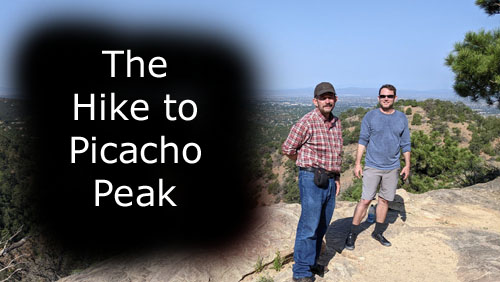
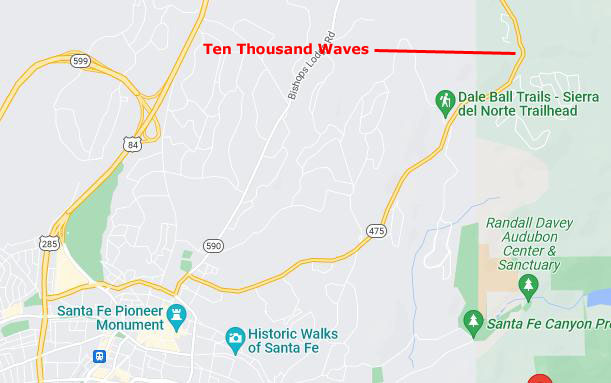
Today, we have three things we want to do. First, Fred, Joseph, and I will be attempting to complete the Picacho Peak Trail; on the peak we expect to have spectacular views of the Santa Fe area. This afternoon, Greg has booked a private patio for us at Ten Thousand Waves, a very upscale spa north of Santa Fe. Finally, this evening, we're going to go to this evening's performance of the Chamber Music Concert Series in downtown Santa Fe.
Hiking the Picacho Peak Trail
The first thing we want to do today is to get a little hiking in. Greg has decided to stay back at the Inn at Vanessie, but we are going to pick up Joseph and drive to the trailhead for the hike to Picacho Peak.
|
The hike to the peak is a 4-mile, out and back trail that takes about two and a half hours to complete. Neither Fred nor I have done much hiking in a while, so we will have to get back into the groove.
|
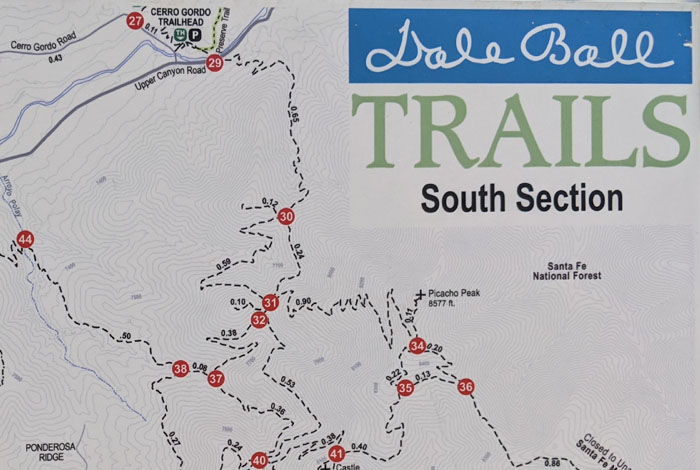
We actually missed this trail map at the beginning; the photo at left was actually taken a ways along the trail, at the spot numbered "30" on the trail map.
That first part of the trail, between stops 29 and 30, was through a pine forest area, and the first part was fairly level, but then halfway along to stop 30, the trail began to ascend steadily, and we began to get good views out towards Santa Fe.
At stop 30, the trail began to ascend much more steeply, and it was along in here that I began to realize that perhaps my hiking days, at least those involving steep ascents, might be coming to an end. Of the three of us, I seemed to be the only one having a problem. It wasn't that I was winded, or couldn't breathe, or that my heart was pounding. No, it just seemed to be a real effort to keep going at a steady pace. By the time we reached signpost 31, I was beginning to think I wouldn't make it to the peak.
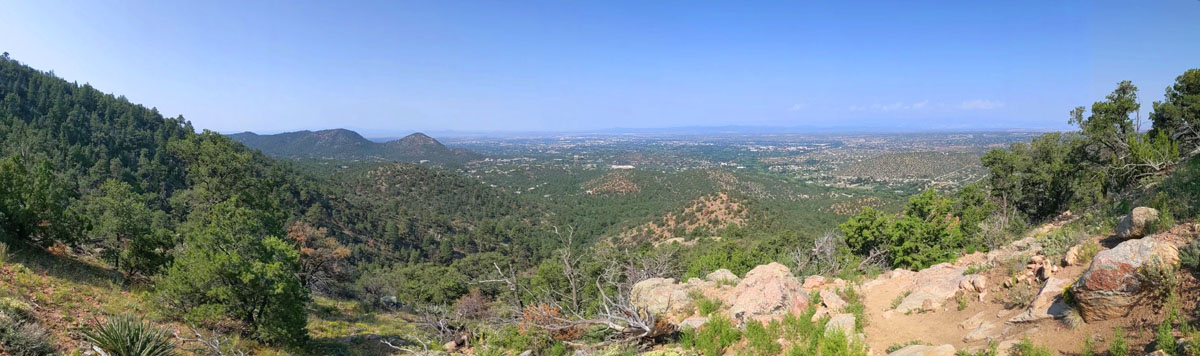
After stop 31, the trail turned left and started into a series of switchbacks. We'd come up only a few hundred feet so far, but the switchbacks would take us up another thousand feet. I want to say that I gave it the good old college try, but halfway through the switchback section, I was exhausted. Not wanting to hold Fred and Joseph back, I suggested they go on to the peak while I waited for them, or continued up the trail at my own pace. After all, the view from here was pretty neat, and even though I wouldn't be getting to the top, the view was well worth the hike so far:
 |
They didn't want to do that, so we stopped perhaps a half-mile short of the peak before turning around and heading back down. Now, we had taken a fair number of pictures on the way up, and I definitely want to include them here. As I have done before, I'll use a slideshow to make it easy for you to go through them quickly, if you wish.
|
I also made one movie, down at the beginning of the switchback segment, and you can use the player below to watch it.
|
|
For my final picture from our hike, I want to show you a panoramic view, taken from the point on the trail where the switchbacks started. This view is a composite of five separate pictures, which just happened to fit together extremely well, and so you can see it close-up, it's in a scrollable window. It is an excellent coda to the hike:
 |
This was the first time I can remember that I haven't finished a hike, and I hope that it was something transient, because I am sure there will be other opportunities for neat hikes in the future, and I don't want to be "the old guy who can't make it to the top". I'm not talking Everest here; I would just like to be able to complete a hike with a 1300-foot elevation gain without wimping out.
At the Ten Thousand Waves Spa
We returned from our hike and had some lunch with Greg and then headed out to the Ten Thousand Waves Spa. Greg had very thoughtfully made a booking for the four of us to have a private spa area for two hours this afternoon. Someone had told him about the spa, and he thought it would be something he would like to experience.
|
 |
The tradition of bathing in hot water goes back millennia due to the abundance of thermal waters in Japan. The Japanese learned early on about the powerful healing and release gained by sitting in hot water surrounded by the beauty of nature. Ten Thousand Waves has taken this model and transplanted it to New Mexico, where nature looks very different but is no less beautiful. They offer a unique 'Japanese-adobe' esthetic, combining the traditional with state-of-the-art technology.
 |
Ten Thousand Waves began as a small bathhouse, eight outdoor hot tubs, and one massage room back in 1981. The emphasis was alway on the salutary effects of hot water. The Japanese bath tradition is mostly about winding down from the day, meeting friends, taking time off with the family, and relaxing. The health benefits are bonuses. Everything is provided to Ten Thousand Waves guests, just as they are at a traditional Japanese inn- the bath experience, good food, and immaculate lodging.
|
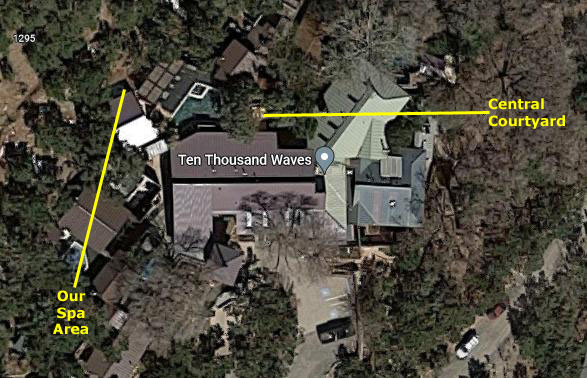
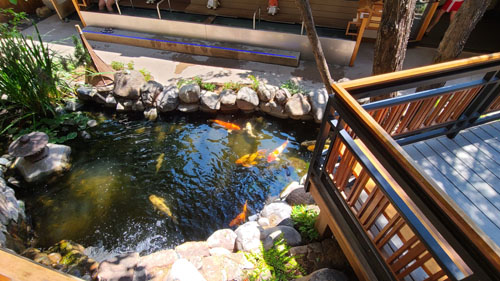
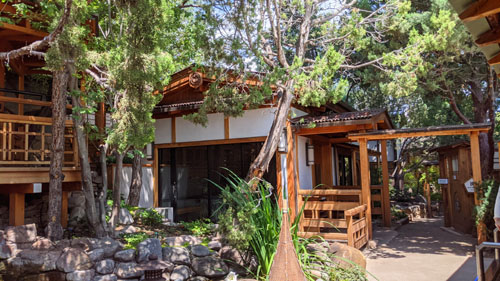
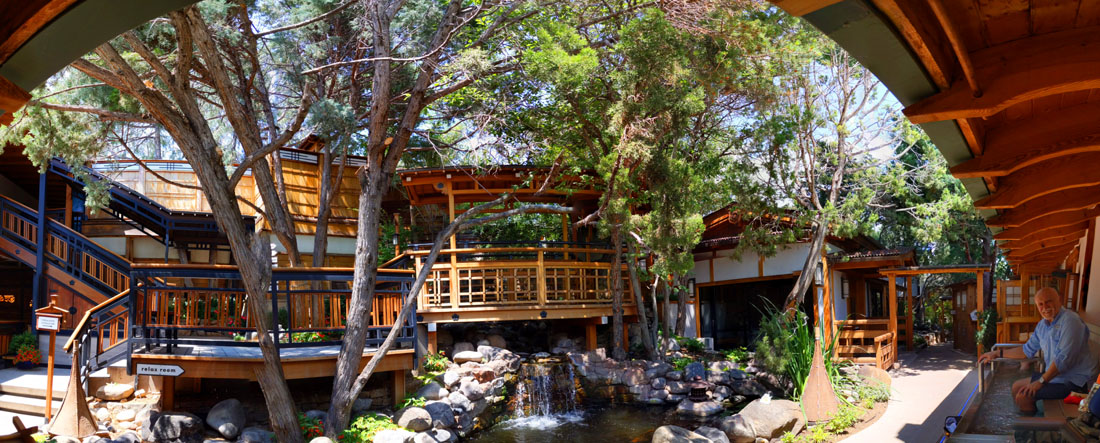
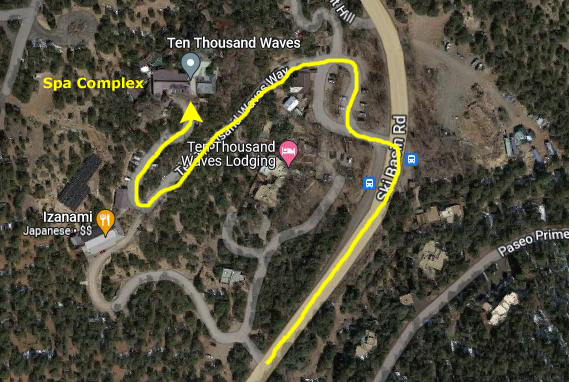
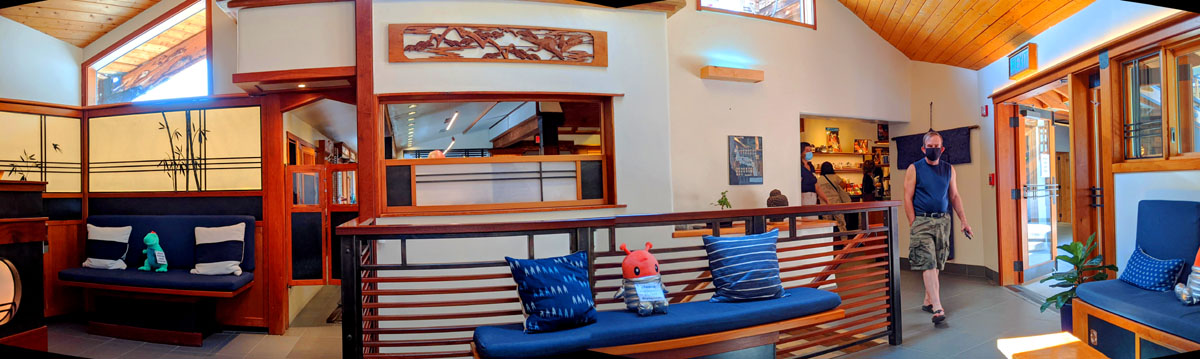
But we are not here for either the lodging or the dining experience, but rather to experience the spa, and to do this we went directly to the spa complex. The building consisted of administrative/check-in area, a beautiful central courtyard with waterfall, bonsai, and a koi pond, a large gift shop and then a variety of rooms, suites, and balconies that are individually-reserved. Greg had booked one of the "hot tub suites".
Ten Thousand Waves has modeled their bathing experience after the great hot spring 'onsen' of Japan. To adapt to American habits, each bathing environment is totally self-contained with a hot tub, sauna, a private changing room and showers, and even a cold plunge pool. (In today's environment, we were also informed on check-in that the alloted time had to be strictly adhered to, since the complex must allow time between each session to disinfect surfaces and to assure that the entire volume of water in the hot tub and cold plunge has gone through a complete filtration/sanitation cycle. Covid is still very much on everyone's mind- even those of us who got fully-vaccinated at our earliest opportunity.
Check-In Administration
 |
The Central Courtyard
|
|
All around the courtyard were multiple levels of redwood balconies- some were walkways to the various suites, while others were balconies for the individual suites themselves.
|
All around the courtyard, the restful, Zen-like nature was evident, and we were encouraged to use the foot-soak bath at one side of the courtyard. It's basically just a long bench with water to rest your feet in, but it was surprisingly relaxing, and allowed us a few minutes to appreciate some of the decorative elements that we saw all around us.
|
The mode is designed for those situations in which you want to photograph something very large but so close to you that you can't get it all in a single image. It is kind of like being able to do horizontal and vertical panoramas at the same time.
You begin by taking a photo straight in front of you, and then you let the camera guide you to which directions you need to point to take additional photos. (It does this by making little dots and circles appear, and when you get each dot inside the circle, you take another photo.)
When you are done, then the phone's camera basically stitches together all the individual photos- but in multiple directions, not just left-right as in a panoramic picture. The camera corrects for perspective (as much as it can) and then saves the finished product. As I recall, the picture of the courtyard was made up of six or seven individual exposures.
Our Spa Suite
|
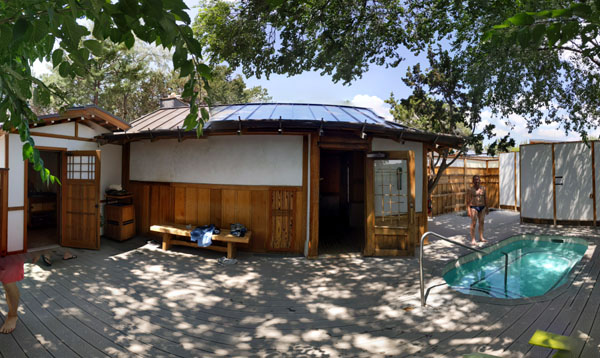
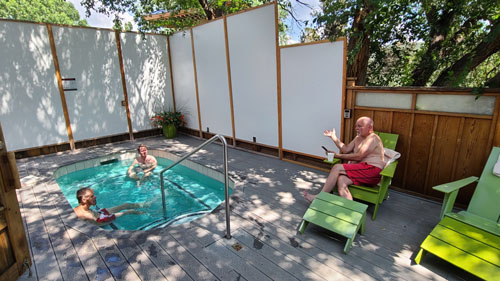
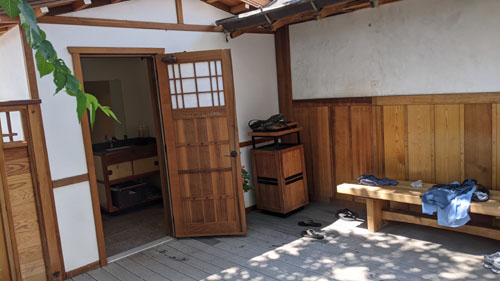
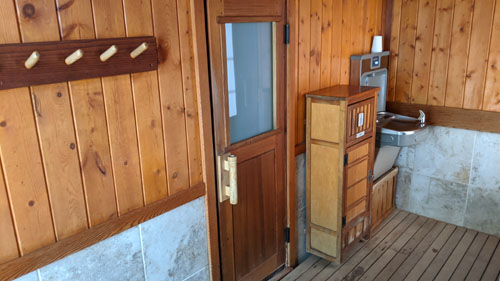
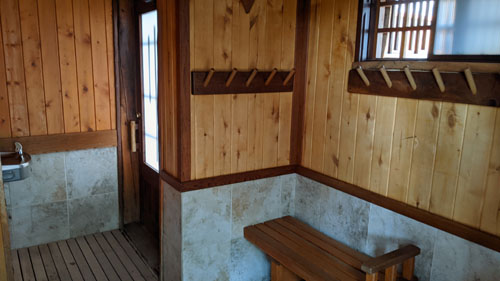
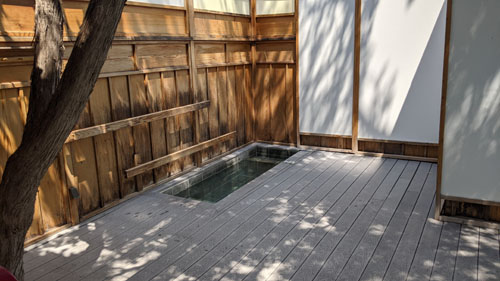
At the left you can see the door to the bathroom, shower, changing room, and sauna. We just used the bench outside, not needing to do all that much changing. At the right you can see the soaking pool. It was warm, being heated, and was about twenty feet by eight feet.
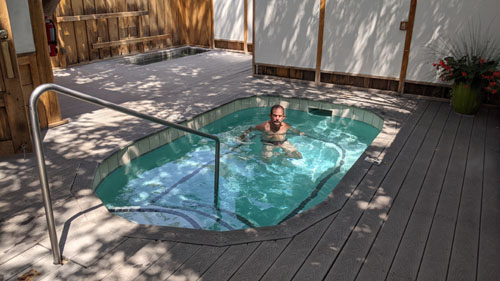
Fred is standing beyond it and behind him, back near the redwood wall, was the cold plunge pool. It was about four by six, with steps at the near end, and the water was very, very cold.
Spread around the area were a few lounge chairs. As you can see, the accommodations were spacious, and we had everything here- at least for the next two hours. During that time we chatted, soaked, and plunged.
Of course I took some pictures and movies during our time here, so let's have a lok at them:
|
|
|
|
|
|
I should probably have consigned to the recycle bin the two movies we made, as they aren't very flattering to the participants. But at least we got some use out of the plunge pool.
|
|
|
I have actually not been to a spa before; although this visit didn't involve massages, mud packs, skin treatments, and other activities one usually associates with a spa, it was very, very enjoyable, and we thank Greg very much for arranging it.
An Evening Chamber "Music" Concert
|
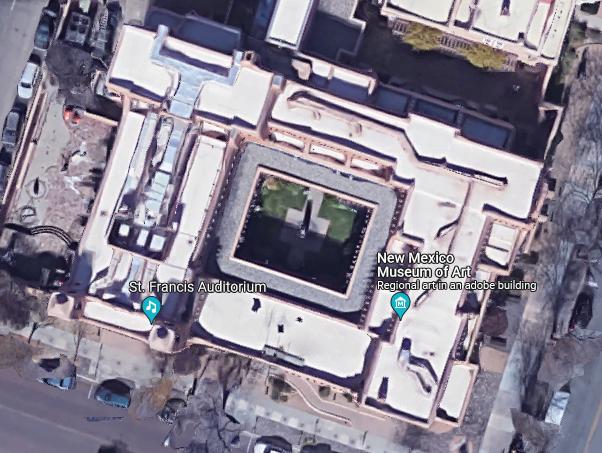
At left you can see an aerial view of the museum building, and the St. Francis Auditorium is marked.
In the Festival's inaugural year, Pablo Casals acted as honorary president. The Festival has contributed to the contemporary chamber music repertoire by commissioning 38 pieces from well-known composers, including Aaron Copland, Ned Rorem, Ellen Taaffe Zwilich, and John Harbison. The festival's executive director is Steven Ovitsky. Marc Neikrug has been artistic director since the late 1990s. I give you these bits of information as background for some comments I'll make below on the music we heard.
The New Mexico Museum of Art is one of four state-run museums in Santa Fe that are part of the Museum of New Mexico, and it is located just a block off the historic Santa Fe Plaza. It was given its current name in 2007, having previously been referred to as The Museum of Fine Arts. The museum’s art collection includes over 20,000 paintings, photographs, sculptures, prints, and drawings from artists such as Ansel Adams, Gustave Baumann, and Georgia O'Keeffe.
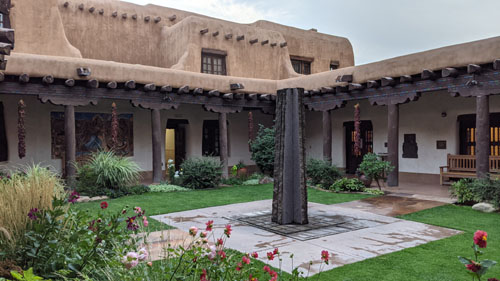
The building was designed by architect Isaac Rapp and completed in 1917. It is an example of Pueblo Revival Style architecture, and one of Santa Fe's best-known representations of the synthesis of Native American and Spanish Colonial design styles. The façade was intended to suggest a mission church, and the open courtyard is reminiscent of those found in the monasteries of churches throughout the Southwest.
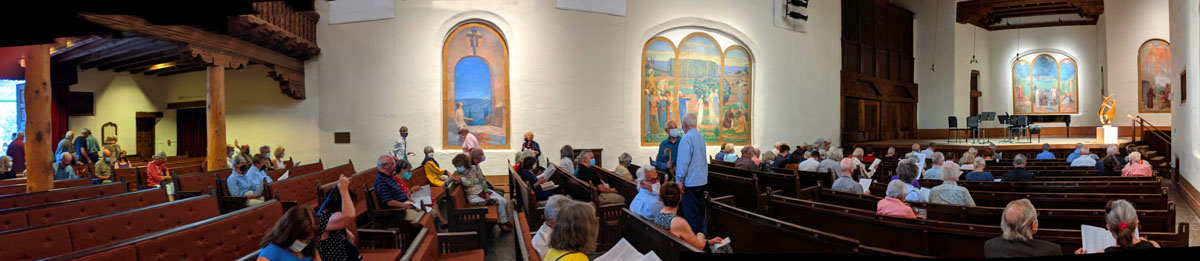
The St. Francis Auditorium is the venue for various cultural and musical organizations. The auditorium can seat 450, and it displays several murals depicting St. Francis of Assisi which were originally designed by Donald Beauregard and completed by Carlos Vierra and Kenneth Chapman.
 |
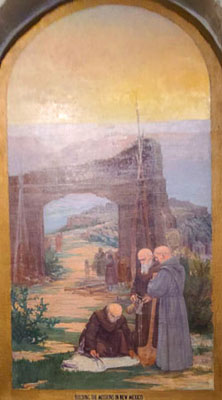 |
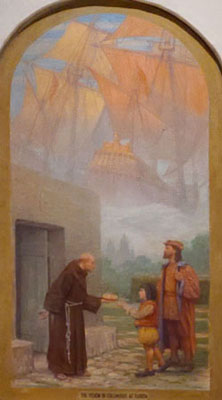 |
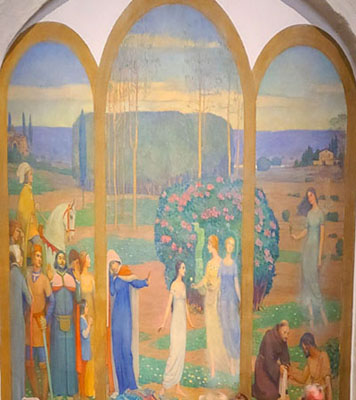 |
Here is a panoramic view of the inside of St. Francis Auditorium just prior to the start of the evening program:
 |
The first short piece was quite nice, but the second, a new work by a modern composer (I have lost the program I saved or I would tell you the name of the piece and the composer) was literally so bad it hurt. After about ten minutes of discordant, unmelodic "music" I finally had to get up as unobtrusively and quietly as possible and make my exit. I've heard music I didn't like before, but never before has it caused an actual, physical reaction.
In any event, I spent the rest of the hour of the concert sitting in the courtyard of the museum, enjoying the early evening coolness and the beauty of the courtyard itself:
|
|
When the concert was over we met up again and walked over to Santa Fe Plaza to find a restaurant and get some supper. We brought the evening to a close early because tomorrow Joseph will be leaving early for his new job in Colorado. Greg will remain, and we plan to drive out to Los Alamos to have a look around.
You can use the links below to continue to another photo album page.
|
August 19, 2021: Santa Fe Trip Day 4 |
|
August 17, 2021: Santa Fe Trip Day 2 |
|
Return to the Index for Our Santa Fe Trip |