|
August 18, 2021: Santa Fe Trip Day 3 |
|
August 16, 2021: Santa Fe Trip Day 1 |
|
Return to the Index for Our Santa Fe Trip |
Today, we'll be checking out of our EarthShip and driving to Santa Fe, where Fred has booked another AirBnB- this time a two-bedroom (we were anticipating that Guy would be with us), two-story townhouse right in the old center of Santa Fe. We will also be meeting up with Joseph and Greg, who arrived in Santa Fe last night.
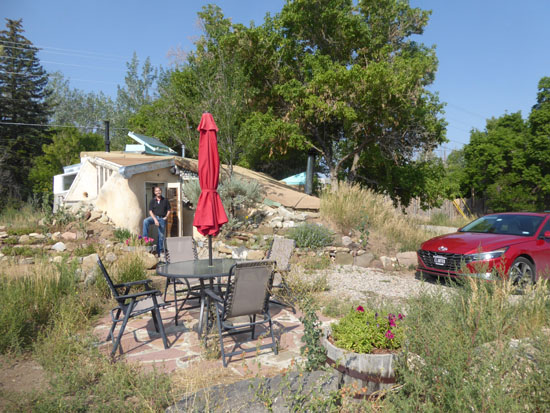
Leaving the EarthShip
In the morning, we tried out the greenhouse shower, and found it worked pretty well; it was like showering on a sailboat, what with the teak flooring and all.
|
|
I was able to step back as well, and get a more panoramic view of our accommodations:
 |
The Drive to Santa Fe
We could have gone down to Santa Fe using the same highway that we'd taken to come up her yesterday, but we opted for a more scenic drive, using New Mexico 518/75; the NM 518 segment is locally known as "The High Road to Taos".
|
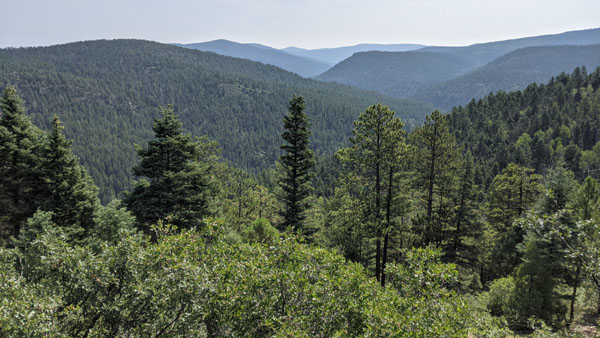 |
The High Road travels through awe-inspiring scenery and remote mountain villages that cling to their Spanish colonial roots. There are also a number of scenic overlooks, and we stopped at a couple of them.
 |
The scenery from the entire 30-mile stretch through the Carson National Forest was simply spectacular.
|
|
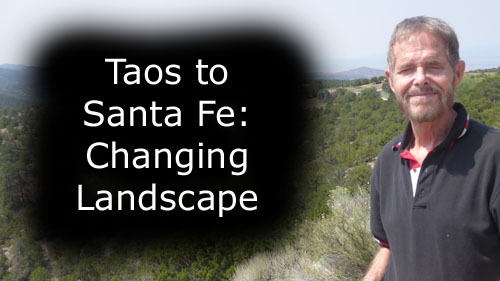
But as we headed south, eventually leaving the Carson National Forest, the landscape began to change. It was slow at first, but by the time we'd gotten more than halfway down to Santa Fe, the trees had disappeared, to be replaced with scrub and bare rock.
|
Image 9/9 was taken along Highway 285 as we neared Santa Fe- and it is the one named feature we passed. If only every tourist boulder, formation, or outcropping was as visitor-friendly as Camel Rock- right off the highway with a parking area and short trail. Camel Rock visually evokes a hump-back desert animal, resting on its legs at the end of a long hot day in New Mexico's Espanola badlands (for a brief time imported camels roamed the Southwest).
Camel Rock is a big chunk of weathered, pinkish-tan sandstone, about 40 feet high and 100 feet long. Historical markers by the road describe the nearby Tesuque Pueblo, known for figurative pottery, but make no mention of Camel Rock. Perhaps it was deemed unnecessary. Camel Rock needs no sign for you to see what it resembles. In late January or early February 2017 the end of the "camel's nose" fell off, but local news reports were unsure if tourists would notice the difference, since what remains still looks like a camel.
Walking Around Santa Fe
The drive into Santa Fe was pretty easy; I have to say, having built-in navigation in the car (I just recently got a new car that has it) made finding our Vrbo lodgings very easy. I'll have more to say about where we stayed a bit later.
|
So we planned to meet up with them later on in the afternoon, and thus had some time to wander around. We have been to Santa Fe numerous times with different people, including Greg, Guy, and Prudence & Ron. We've also been there on our own, and so we have seen or visited almost every tourist stop in town. You've seen the Loretto Chapel, Canyon Road, the State Capitol, the Georgia O'Keeffe Museum, the Cathedral, and many other sites in these album pages.
So now we usually just take pictures of the new, the colorful, and the quirky, and these pictures don't fall into some continuous tour path that one might take through town. So if the pictures in this section seem a bit disorganized, that's because they are.
|
|
The reactionary movement away from the Americanization Period defined a unique "Santa Fe Style". It intended to preserve the qualities of old Santa Fe and to attract both tourism and population growth.
Santa Fe Style includes three distinct architectural types- Pueblo-Spanish Revival (aka Spanish-Pueblo or Pueblo Revival); Territorial Revival; and Santa Fe vernacular. While you might not see all three of these styles in today's pictures, we've seen numerous examples of all of them in the times we've been here (and our lodgings this time are of the "Pueblo Revival" style).
But "Santa Fe Style" today means much, much more than just a set of architectural styles. Today it refers generally to a style of clothing (particularly women's clothing), jewelry (particularly women's jewelry), and interior design. In Santa Fe, there is even a magazine devoted to "Santa Fe Style" (which, of course, can be purchased wholesale).
|
 |
|
 |
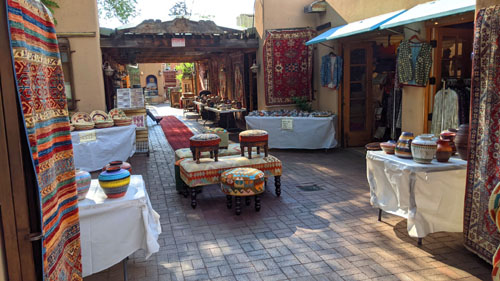
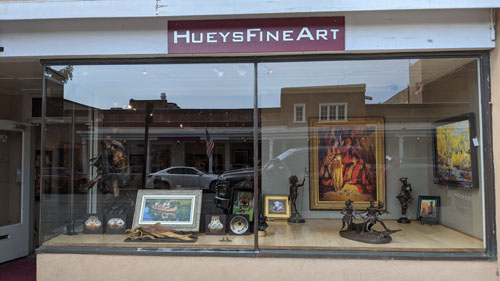 This is one of the many art galleries all over town- all supporting Santa Fe Style. |
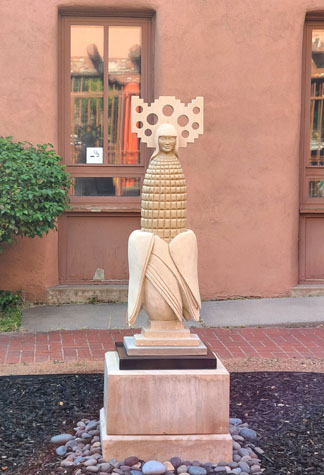
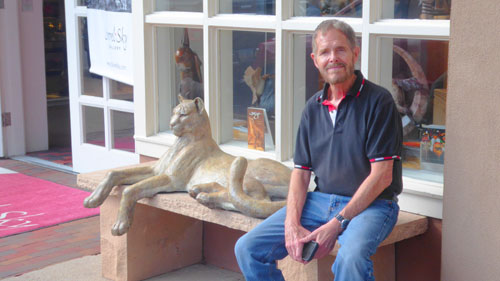
 And sculpture is everywhere! |
One of the city landmarks is the Cathedral Basilica of Saint Francis of Assisi.
|
The cathedral was built by Archbishop Jean Baptiste Lamy between 1869 and 1886 on the site of an older adobe church, La Parroquia (built in 1714–1717). An older church on the same site, built in 1626, was destroyed in the 1680 Pueblo Revolt. The new cathedral was built around La Parroquia, which was dismantled once the new construction was complete. A small chapel on the north side of the cathedral was kept from the old church.
Influenced by the French-born Archbishop Lamy and in dramatic contrast to the surrounding adobe structures, Saint Francis Cathedral was designed in the Romanesque Revival style. As such, the cathedral features characteristic round arches separated by Corinthian columns and truncated square towers. The large rose window in front and those of the Twelve Apostles in the lateral nave windows were imported from Clermont-Ferrand in France.
|
(Mouseover Image if Video Controls Not Visible) |
The towers were originally planned to be topped with dramatic 160-foot steeples, but due to lack of funds, these were never built. The north tower is a single row of bricks taller than the south tower. The cathedral was built from yellow limestone blocks quarried near the present site of Lamy. A 2005 addition to the upper façade of the cathedral is a small, round window featuring a dove, the symbol of the Holy Spirit. It is a stained glass replica of the translucent alabaster window designed in the 17th century by the Italian artist Bernini for St. Peter's Basilica in Vatican City.
The Cathedral of Saint Francis of Assisi was officially elevated to a basilica by Pope Benedict XVI on October 4, 2005, when it was named the Cathedral Basilica of Saint Francis of Assisi.
A fictionalized account of the cathedral's origins is included in Willa Cather's Death Comes for the Archbishop. Due to its prominent location off the plaza, many artists who have lived in or visited Santa Fe have captured its image in their work.
The Pueblo-Spanish Revival style was defined in 1912 by the "New-Old Santa Fe Exhibition" held in the Palace of the Governors and subsequently with the Palace's remodeling including replacement of the Victorian front portal with another portal in the new style.
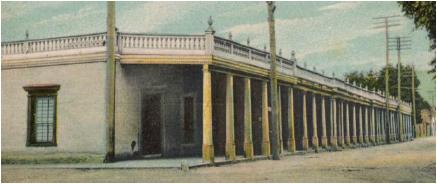 |
became | 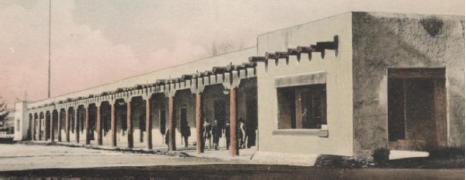 |
Some of you might remember that the Palace of Governors appeared on a postage stamp from the 1950s- worth the princely sum of 1 1/4 cents.
|
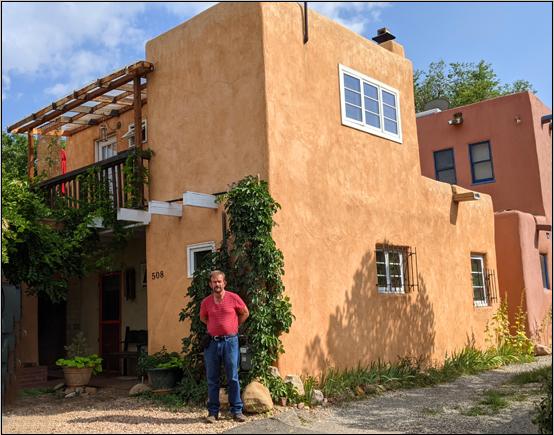
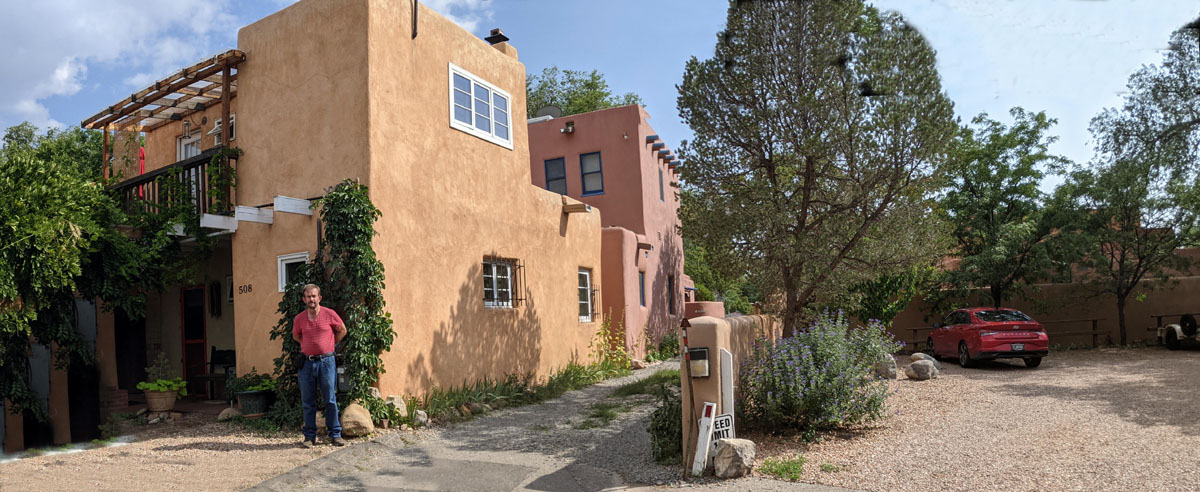
Take a look at an outside picture of the lodging Fred found for us here in Santa Fe, and I don't think you will have any trouble concluding that it is a textbook example of the Classic Pueblo-Spanish Revival style.
|
 |
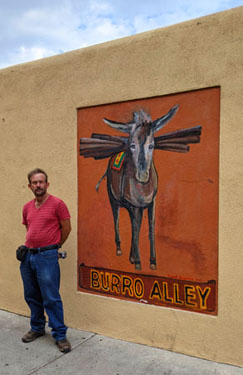
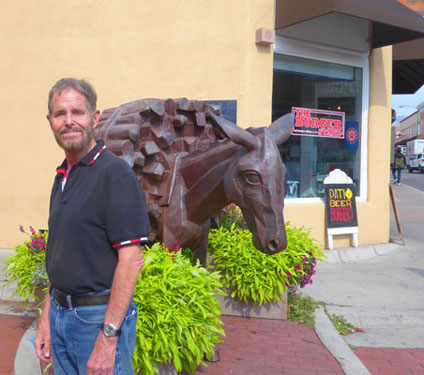
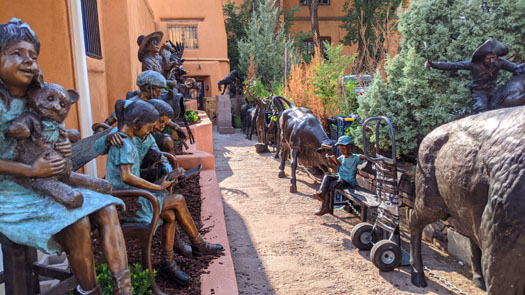
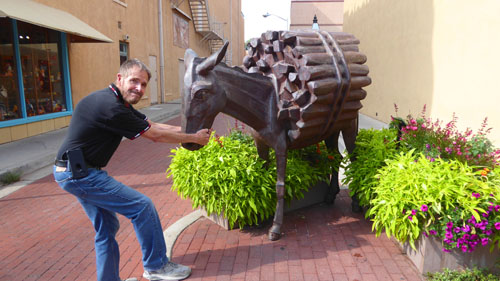
At another point in our walk, we came upon a narrow alleyway that seemed to be the display area for a store selling sculpture, one of which was Fred's favorite- the buffalo.
|
|
Just to complete the survey, the third architectural element of Santa Fe Styis is the Territorial Revival style- a result of the Americanization Period's effect on mud-plastered adobe-walled buildings using new methods of construction with commercially-prepared materials.
|
|
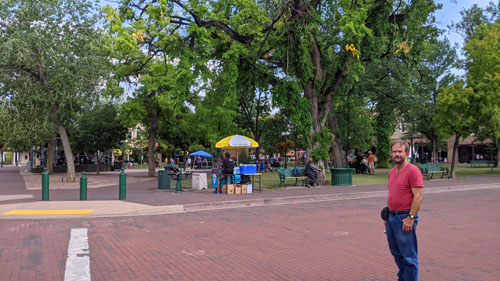
Late in the afternoon, we got in touch with Greg. They had arrived and we arranged to meet up in Santa Fe Plaza. The Plaza is a National Historic Landmark, and is in the style of traditional Spanish-American colonial cities. The plaza, or city square, was originally, and today still is, the center gathering place in town. Many know it as "the heart of Santa Fe".
 |
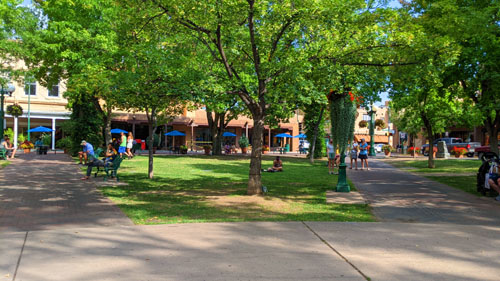 |
The landmark has since grown into a playground for many tourists interested in Spanish, Native American, and Mexican cultures, and includes music, design, jewelry, art and dance. It is home to annual events including Fiestas de Santa Fe, the Spanish Market, the Santa Fe Bandstand, and the Santa Fe Indian Market.
|
|
At first, the group seemed to be just practicing or doing sound checks, but after a while they began playing full tunes. When they began another one, I thought to make a movie with the music as background. What I didn't count on were the women who came in from the right a few seconds into the movie.
I have no idea who the women were- tourists or residents- but one thing was sure: they had come prepared to show off their "Santa Fe Style", as each was dressed in outfits somewhere between Urban Cowgirl and Hispanic Matron. You can't see it in the movie, but from head to toe, including lots of turquoise jewelry, they were the epitome of "Santa Fe Style for Women". Use the movie player at left to see and hear the goings on in Santa Fe Plaza this afternoon.
We hadn't seen Greg and Joseph yet, but a quick phone call revealed that they were entering the plaza, so we were able to hook up with them quickly.
|
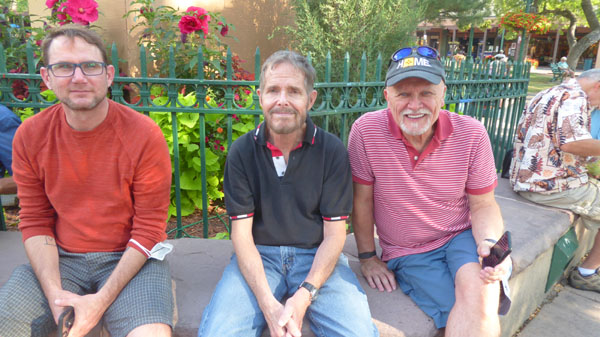
We enjoyed sitting here and listening to the music and watching the people for a while.
After New Mexico was admitted as the 47th state in 1912, a historic preservation plan was established. The plaza is now marked by structures in the Pueblo, Spanish and Territorial styles that reflect its history. Among the most notable are the original palacio, the Palace of the Governors, built between 1610 and 1612 and San Miguel Mission, a noted landmark (c. 1640), and one of the oldest churches in the United States. The plaza is surrounded by restaurants, shops, and museums. Many seasonal community events are held at the plaza, and it is then filled to capacity with people enjoying the magic that is "The City Different".
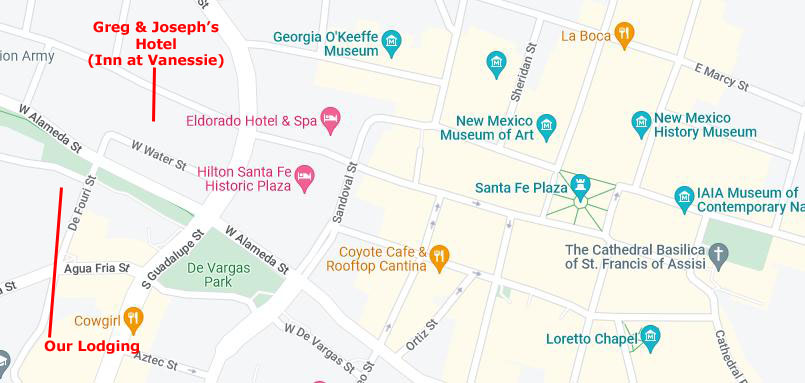
Eventually, we went back to the hotel where Greg and Joseph were staying, to have a look at their accommodations (which were very nice). Then we walked over past our own lodgings to an area where there were numerous restaurants, and we found one serving barbecue.
Our Lodgings in Santa Fe
On the map above, I marked the location of the apartment that Fred found for us (and Guy). It was very convenient to downtown, and we could walk everywhere. Here is a view of the apartment/house behind Fred and our parking space across the drive:
 |
On the second day, we learned that there was a cooperative pet that was apparently shared between two other homeowners adjacent, but the little cat was an equal-opportunity dispenser of cuteness.
|
For some reason, I didn't take pictures of the inside of the "townhouse", but I would like to describe it- in case you are someone planning a visit to Santa Fe and will be looking for a spacious place near downtown.
First, the house was divided into two parts. On the ground floor, just near where I am sitting with the cat, there is a door that leads into a small, studio suite. This room, perhaps 150 square feet, had a bed, a small living area, and a full bath. This was where Guy would have stayed had he been with us, for it is entirely private.
A few feet away, is the door to the main apartment. Coming in through this door (you are facing north as you do so), you find yourself at the east end of the long galley kitchen. So, when you turn left and go through this full kitchen, you are in the downstairs living area. This area, longer than it is wide, is perpendicular to the kitchen, so if you want to walk the length of this room, you would turn left and be walking south. This living area had a couch, tables and chairs, the television, bookcases, and such.
|
Turning left one more time, the bedroom is ahead of you and the bath is to your left. The way the two parts of the home are arranged, the bedroom and bath on the second floor are basically what's above the separate apartment on the first floor.
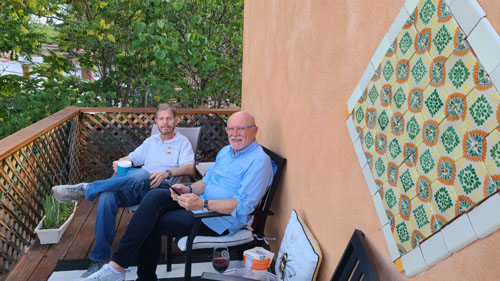
At right are myself and Greg on our second afternoon here in Santa Fe, sitting on the south balcony. Fred is taking the picture from the southeast corner of the second floor; the balcony continues around the east side of the structure to Fred's right. You can see this portion of the balcony in the panoramic picture above.
It has been an interesting day, and we were all looking forward to a good supper, which we certainly had at the barbecue restaurant we found about three blocks away.
You can use the links below to continue to another photo album page.
|
August 18, 2021: Santa Fe Trip Day 3 |
|
August 16, 2021: Santa Fe Trip Day 1 |
|
Return to the Index for Our Santa Fe Trip |