|
July 10, 2021: A Musical by the Uptown Players |
|
May 14 - June 5, 2021: Our Early Summer Trip to Florida |
|
Return to the Index for 2021 |
Our visit to the San Antonio Botanical Garden came in the middle of one of our many trips to San Antonio to visit with Prudence and Ron. But since all the pictures we took on this trip to San Antonio were actually taken at the Botanical Garden, I've chosen to title the page differently. Our actual visit was July 2 through July 5; we returned to Dallas on July 6.
Getting to the Ruckman's House in San Antonio
On the left-hand map below, you can see the normal route from Dallas down to San Antonio. Not much explanation is necessary; sometimes we take the bypass around Austin, but most times we don't, and the trip to the San Pedro exit in San Antonio is usually four hours plus.
We head north on San Pedro Avenue a couple of miles and then either hang a left on Ashby and a right on Breeden or just a left on French to get to the Ruckmans' house on the northeast corner of Breeden and French.
 |
In case you have not seen them, I have put below first an aerial view of the Ruckmans' house (it is the house on the corner and the garage/apartment building north of it where Guy lives) and a front view of the house (taken in 2010).
 |
Getting to the San Antonio Botanical Garden
|
The 40-acre, non-profit Botanical Garden was first conceived in the 1940s by Mrs. R. R. Witt and Mrs. Joseph Murphy, who organized the San Antonio Garden Center. The two went on to develop a master plan for a city botanical center in the late 1960s. The site of the master plan was a former limestone quarry and waterworks area owned by the city. Voters approved $265,000 in bonds in 1970, which was the catalyst for funding the new gardens. Ground was broken for the new facilities on July 21, 1976 and the San Antonio Botanical Gardens officially opened to the public on May 3, 1980.
The gardens have had two major additions since opening. On February 29, 1988 the Emilio Ambasz designed Lucile Halsell Conservatory opened to the public and later that same year the historic Sullivan Carriage House was moved brick by brick to the botanical garden. Restoration of the building began in 1992, with formal dedication in 1995. The botanical gardens has also just completed a major expansion, and the entrance has been moved from the Sullivan Carriage House to a new entry plaza about 200 feet south.
|
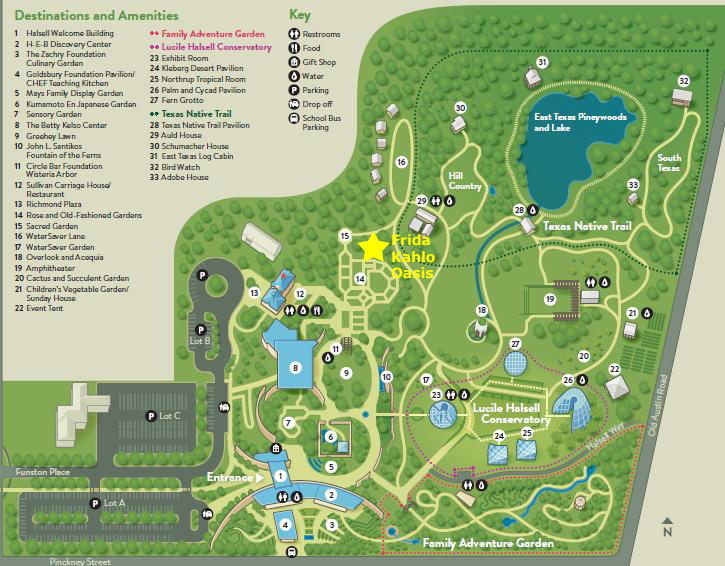
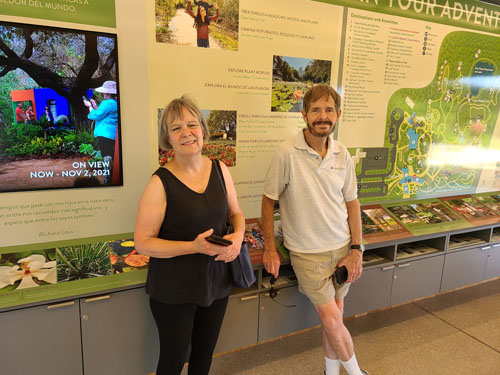
To help organize the pictures we took, and to help you follow us on our wanderings, I want to use the garden diagram that is available at the entry plaza. I have reproduced that map at right, and I will try my best to tell you where we went by referring to the numbers on the map.
I think this will be better than trying to draw a continuous path on the map, as we did a lot of wandering back and forth. So please come back to this map frequently if you want to see just where in the garden something in particular can be found.
Entry and Culinary Garden
We entered the botanical garden through the new Halsell Welcome Building (1). The structure encompasses a gift shop and the entry kiosk. We have memberships at the Dallas Arboretum, and they have a reciprocal arrangement with quite a few other gardens across the country- including the San Antonio Botanical Garden.
|
On our way through this breezeway to the culinary garden, Fred had Prudence and I stop so he could take the picture at left.
This small garden and area are devoted to plants that are used for food- either vegetables, fruits, or seasonings. The Dallas Arboretum has a similar garden in its new expansion area called "A Tasteful Garden". Just through the breezeway there is a small water feature that includes a pool with blooming aquatic plants.
|
We wandered around this garden area for a bit, and here are four other pictures that we took while we were here:
|
Walking to the Frida Kahlo Oasis
Our main objective in coming to the garden today was to see an exhibit called the "Frida Kahlo Oasis", and that was where we wanted to go first.
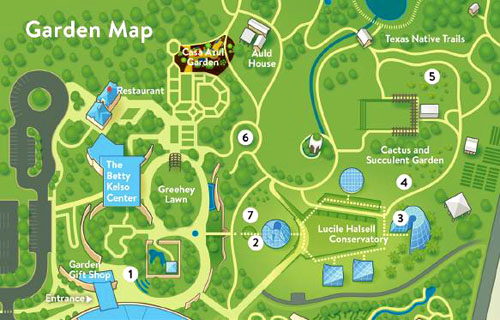
|
|
The little number, we discovered, refers to the location of one of the large sculpted animals that are also on display throughout the gardens at the moment.
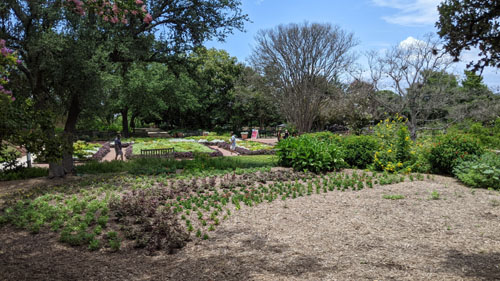
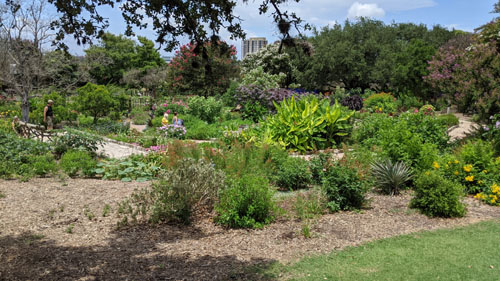
We made our way northward past the Greehey Lawn and the numerous beds of plants scattered about. Here are some of the views along this section of the walk:
 |
 |
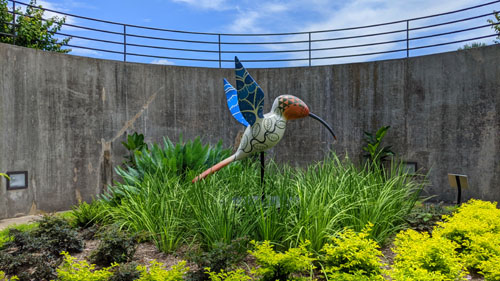
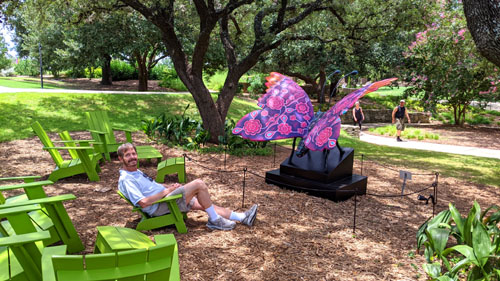
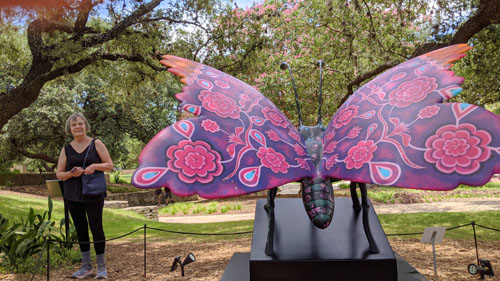
As we walked north to the Frida Kahlo Oasis, we passed one of the monumental animals that are currently on display in the gardens. The animals- a Dog, Monkey, Deer, Butterfly, Parrot, and Hummingbird- often appear in Kahlo’s artworks, and they have been installed here as a testimonial to her passion for Mexican Arte Popular:
 |
 |
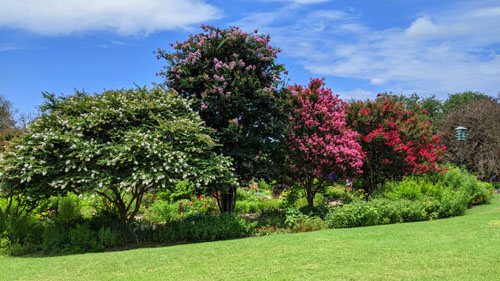
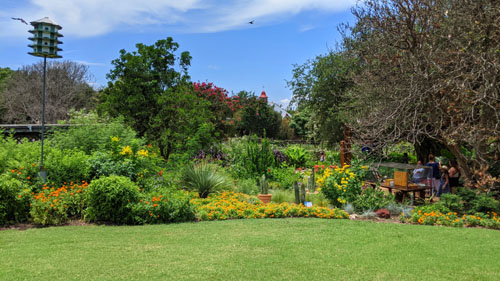
Then we walked the last short distance to the Frida installation, passing multiple gardens and the crepe myrtles in full bloom:
 |
 |
The Frida Kahlo Oasis
We came down the walk from the butterfly to the entry to the Oasis, and I got a very nice picture of Prudence just outside the Oasis.
|
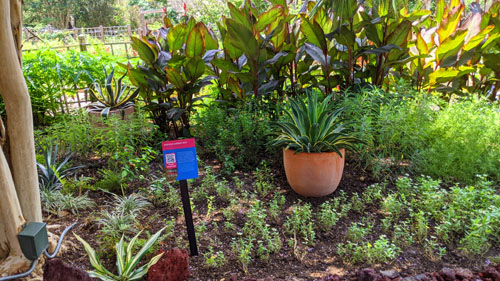
Just outside the entrance to the Oasis there was a small rectangular garden bed, and a nearby sign called it the "jardineras de bienvenida" or Welcome Garden.
The sign went on to say that "inspired by the desert landscapes of Mexico and its colorful native flowers, the Welcome Garden Beds line the entryway with agave, sotol, and prickly pear surrounded by colorful marigolds and lantana."
The facade itself was very interesting, and there was an explanatory sign at the entrance that described this replica of the actual facade of Casa Azul, built in 1904 in Mexico City. There was also a picture of the actual Casa Azul facade, which I had never seen.
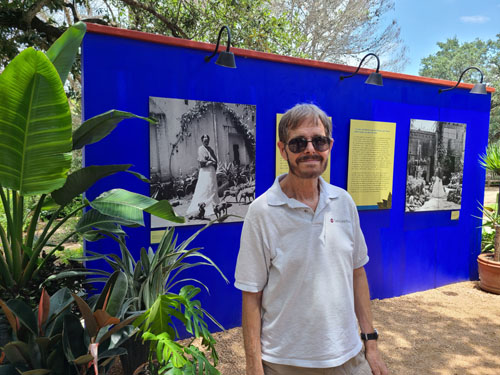
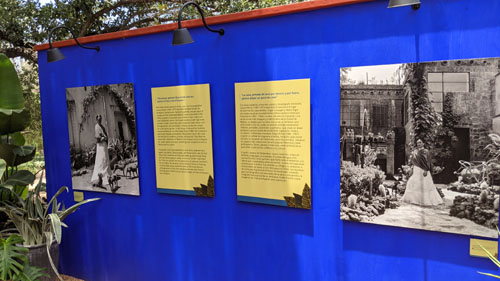
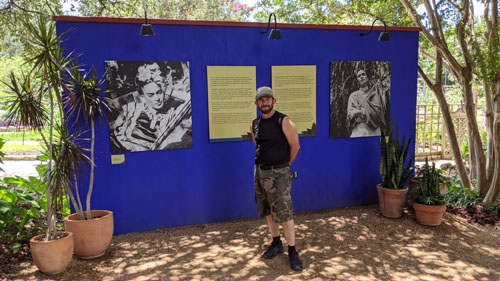
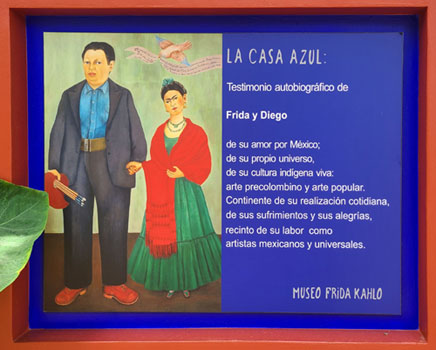
Going in through the entrance, the first thing we encountered was a display wall that talked more about the Blue House (Casa Azul), and we all thought the information and old pictures were very interesting.
|
|
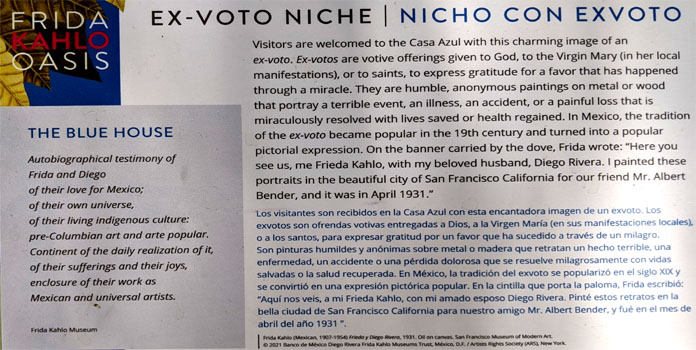
Next, we came by the "Ex-Voto Niche", and I had no idea what this was all about until I read the explanatory information provided. Here is the "ex-voto" and the explanatory placard:
 |
 |
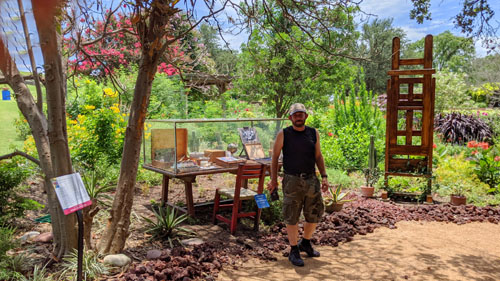
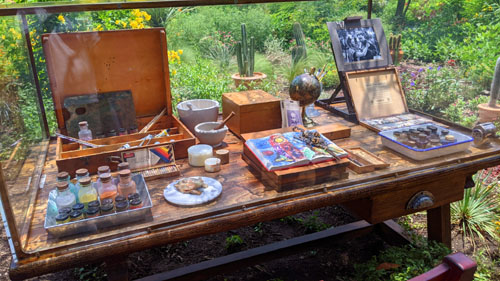
We'll talk more about the Casa Azul garden presently, but there were a number of displays that we were able to take a look at, including Kahlo's desk and easel. In the left-hand picture below, just click on the little sign at left and I will blow it up so you can read it.
|
|
The 2100-square-foot exhibit area encompassed a number of small gardens that Kahlo had at Casa Azul. Here are two of them:
(Click on Sign to Read) |
(Click on Sign to Read) |
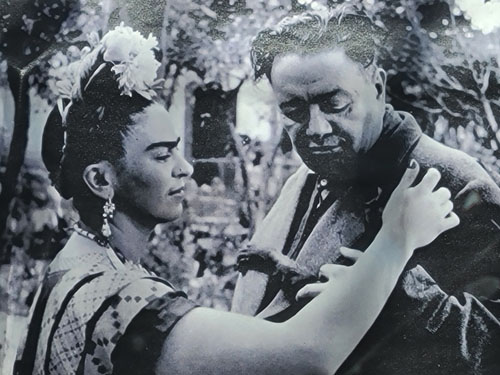
The Oasis was full of little nooks and crannies, things to interact with, and pictures of Frida Kahlo and her husband.
 |
 |
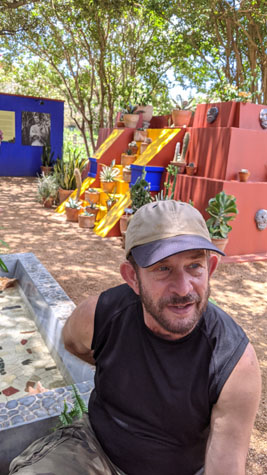
Here is an enlarged view of the picture I am sitting in front of above, along with the quote at the top of the display and the information about the photograph.
|
 |
The title of the photograph is, appropriately, "Frida Kahlo Feeding Ducks". It was taken in 1951 by German-born French photographer Gisele Freund (1912-2000). The photo below looks back at the entry:
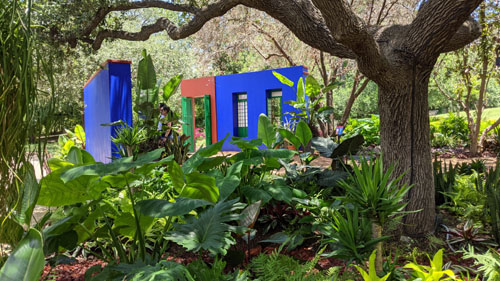 |
Here are a couple more photos from inside the Oasis:
 |
 |
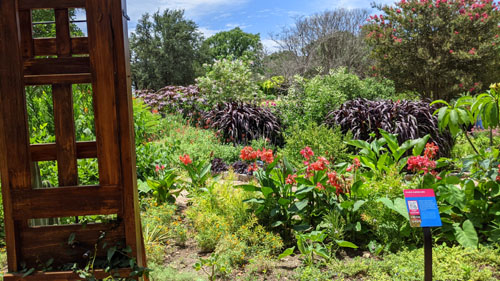
The Casa Azul garden is nestled in the heart of the Botanical Garden, shaded by giant oak trees, and overflowing with Mexican native plants, and a mixture of tropical foliage and desert plants, including elephant ears, bougainvillea, agave, and marigolds.
|
|
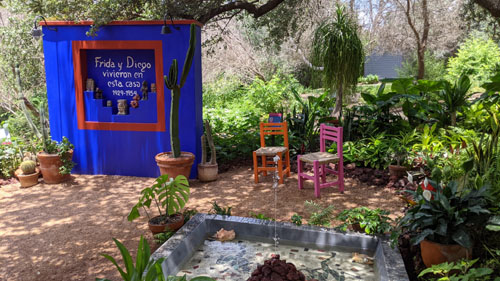
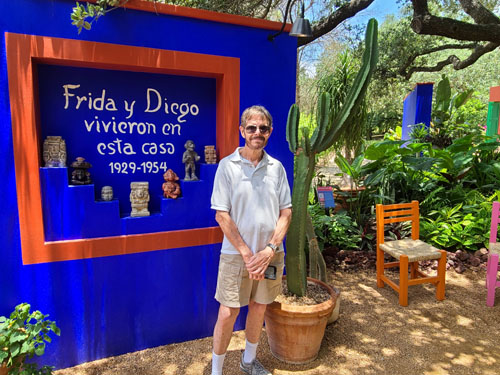
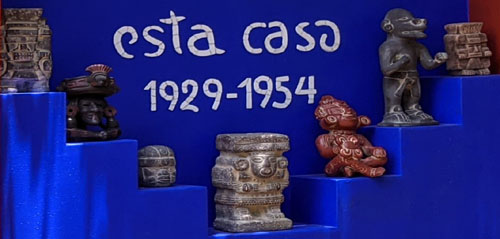
Elsewhere, we found another "niche" that is a reproduction of one found in the original courtyard of Casa Azul itself. Inscribed in letters crafted in Mexican white tile, the message reads: "Frida and Diego lived in this house, 1929-1954".
|
 |
If you would like to read about the figurines themselves, please click here.
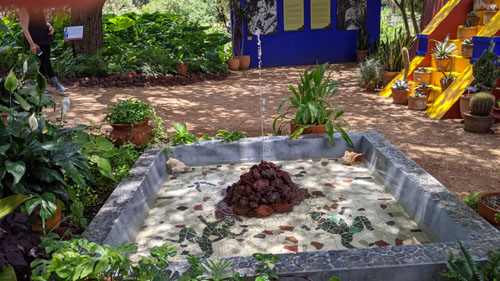
The last two elements of the Kahlo Oasis that we saw were the toad fountain, and the "pyramid", both of which are reconstructions of the actual elements of Casa Azul. First, here are a movie and picture of the Toad Fountain:
(Mouseover Image if Video Controls Not Visible) |
|
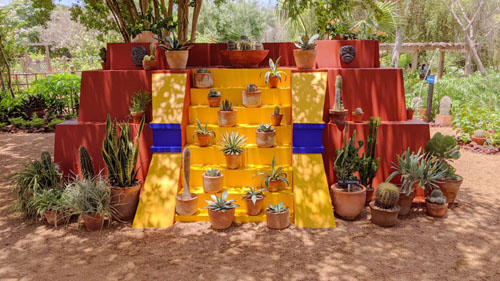
Another famous landmark of Kahlo’s garden at Casa Azul was the pyramid that displayed Diego Rivera’s pre-Colombian artifacts collection.
|
 |
The gardens of Casa Azul were influenced by both Frida Kahlo and Diego Rivera. The four-tiered pyramid was built to showcase Diego's collection of pre-Hispanic art. The frog-themed fountain reflects Frida's nickname for Diego (toad). This is the heart of Casa Azul garden, where you will find tropical plants and succulents; bougainvillea, calla lilies, and agave.
We enjoyed our time in the Kahlo Oasis. Having seen numerous movies and documentaries about Kahlo and Rivera, we were pleased to see the horticultural aspect of their relationship.
The Rose and Old-Fashioned Gardens
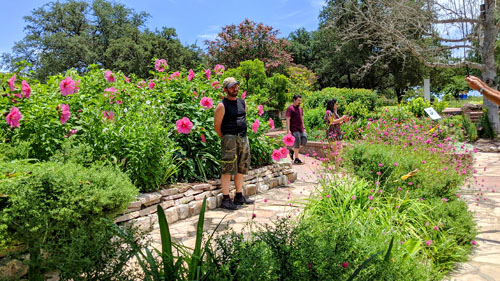
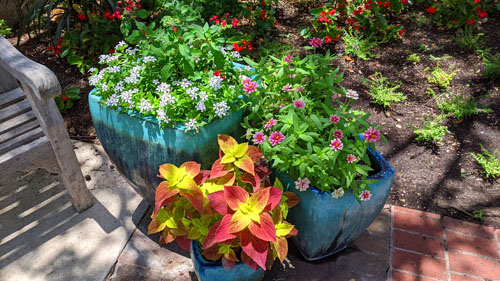
We left the Kahlo Oasis, walked a bit south, and found ourselves in the oldest section of the Botanical Garden. Here, we found a series of formal and specialty gardens featuring brick-bordered beds. In the Old-Fashioned Garden- an Official Monarch Waystation- we found older flower varieties popular in eras past. There was also a series of Rose Gardens, along with other specialty gardens such as the Sacred Garden, the Shade Garden, Gertie’s Garden and other garden displays like the Herb Garden, which is tended by volunteers.
These gardens are not isolated, but intermingled. And other than the plant varieties themselves, the individual garden areas aren't delineated or labeled. So all I can do here is to simply show you the various pictures we took in this area of the Botanical Garden.
 |
 |
 |
 |
 |
 |
The Lucile Halsell Conservatory
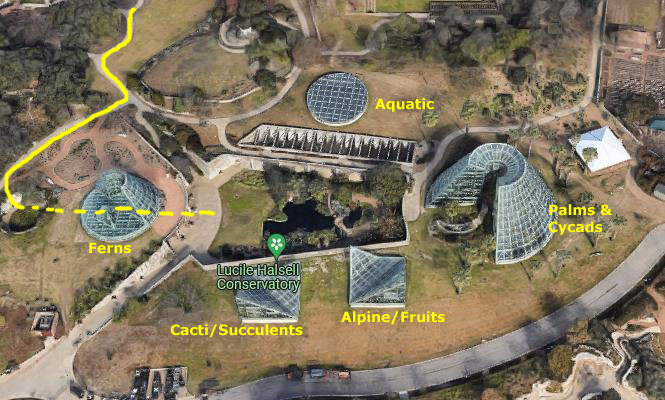
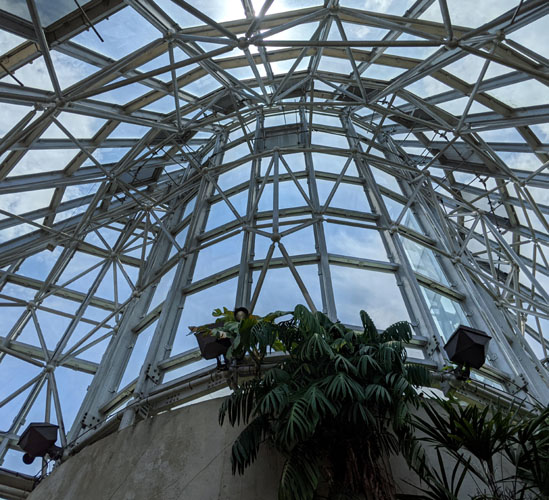
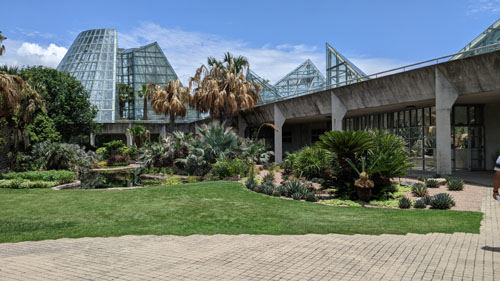
A bit south and east of the display gardens is one of the crown jewels of the San Antonio Botanical Garden- the Lucile Halsell Conservatory. Built in 1988 and designed by award-winning Argentinian architect Emilio Ambasz, this partially-subterranean structure consists of five climate specific greenhouses surrounding a central courtyard.
|
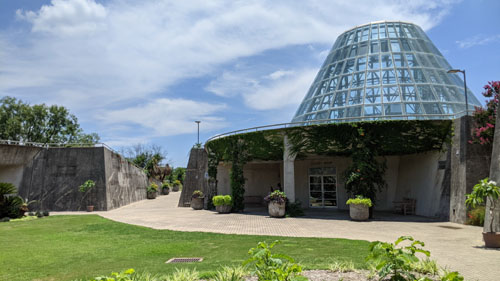
One of the things we always do when we come to the Botanical Garden is to walk through the first greenhouse (the one at left) which brings us into the below-grade courtyard, from which we can enter all of the other greenhoues.
Each greenhouse focuses on a certain class of plants. The circular one we enter first is devoted to ferns and aroids, orchids, and other plants. The other large circular greenhouse is for palms and cycads. Other specimens housed in the structures include alpine plants, aquatic plants, cacti and succulents, carnivorous plants, epiphytes, and tropical fruits. The building (although there are separate greenhouses, they are all considered to be one building) has won several architectural design awards.
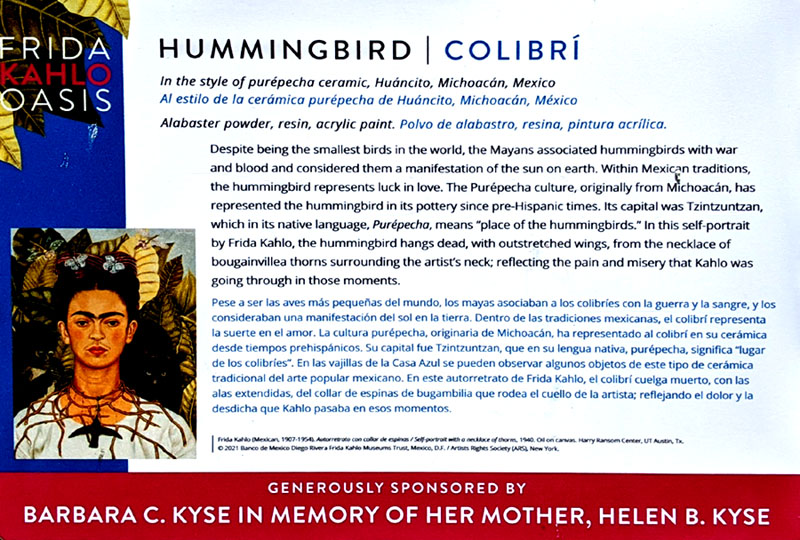
We came down from the Oasis to enter the first of the greenhouses and ran across another of the monumental animals at the below-grade entrance on the west side of the structure.
|
If you would like to read about this particular sculpture, just click on the sign image below:
This first greenhouse is one of two that are circular and quite tall- the other being the palm and cycad house, which we will get to presently. The superstructure of these two greenhouses (and indeed the others as well) is an artwork in itself.
|
I have made movies in some of these greenhouses before, but the one I made today of the orchid/fern house was, I think, particularly good, and you can use the player below to watch it:
|
(Mouseover Image if Video Controls Not Visible) |
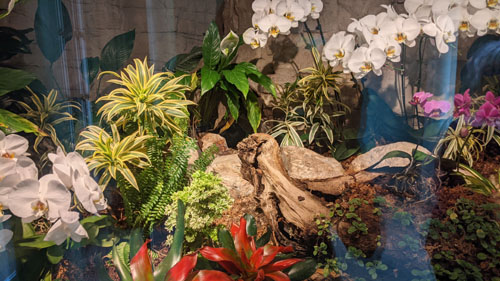
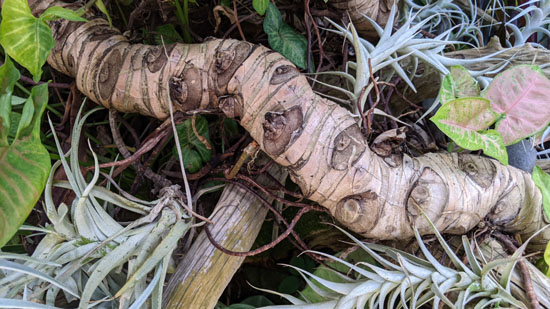
Here are some additional pictures that we took in this first greenhouse:
|
|
 |
 |
|
|
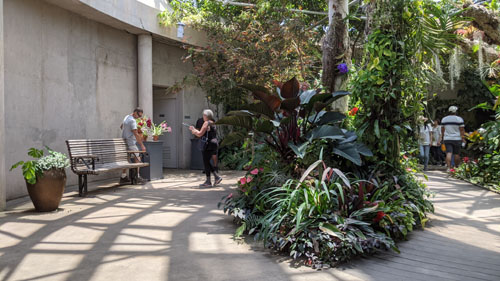
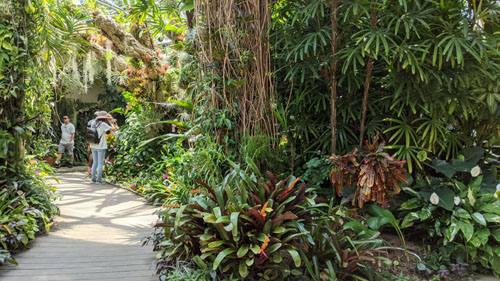
When you exit this first greenhouse to the east, you are somewhat below grade in a courtyard that has various plantings and a pond. You can see that the area is below grade as just to your left will be a pathway up to the gardens. Here are a couple of views in the courtyard:
|
|
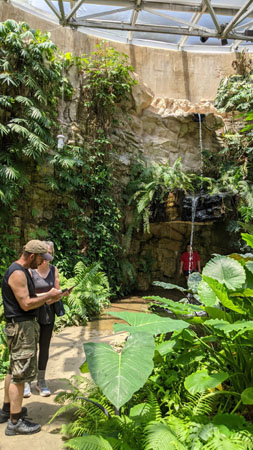
As we usually, we explored some of the other greenhouses. To our left, on the north side of the courtyard, is the greenhouse housing aquatic plants.
|
Waterfalls are exceptionally neat, and the walkway here in this greenhouse allows you to actually go behind the waterfall, so I thought I would make a movie as I did so. You can use the player below to watch that movie:
|
(Mouseover Image if Video Controls Not Visible) |
I left Prudence, Fred, and Guy for a little while and went into the Palm and Cycad House. That house features a pathway that you can walk to the top of the greenhouse, where there is an exit outside to the gardens themselves.
|
Then I walked down the length of the circular walk, making a film as I went, and you can use the movie player below to watch the result of my efforts:
|
(Mouseover Image if Video Controls Not Visible) |
When I came out of the Palm House to rejoin everyone else, I passed by the other two greenhouses, and just snapped a picture inside each one:
|
|
When I rejoined everyone, I found them sitting on a bench with each one absorbed in his smartphone- much like most young adults do these days. I had to get them to divert their attention so I could get a picture:
 |
 |
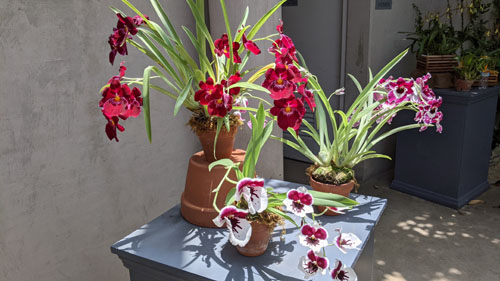
I took three more pictures before we left the conservatory to head back to the Botanical Garden entrance;
 |
 |
 |
It as very warm, so, having seen the Kahlo Oasis (which is what we'd come for originally) we decided to call it a morning and head back to the Botanical Garden Entrance and head home. The San Antonio Botanical garden is an amazing place. In addition to what we saw today, there is the Kumamoto En, a Japanese garden reflecting styles and techniques from Kumamoto's 300-year-old Suizenji Park and from Katsura Detached Palace garden in Kyoto. There is also a "Native area"- showcasing plants and structures from the East Texas piney woods, Texas Hill Country, and South Texas.
You also might want to visit the Sullivan Carriage House- designed in 1896 by noted architect Alfred Giles for banker Daniel J. Sullivan. The structure was relocated, brick by brick, in 1988 from its original location in downtown San Antonio to the Botanical Gardens. The building was fully restored and dedicated in 1995. Prior to the latest expansion of the gardens, the structure was the main entrance to the gardens and its former stables and carriage house contained a restaurant, gift shop, and offices as well as event and meeting space. It is now just the restaurant and offices.
Our visit to the Botanical Garden was the only time I took pictures on this trip, so that brings this page to an end.
You can use the links below to continue to another photo album page.
|
July 10, 2021: A Musical by the Uptown Players |
|
May 14 - June 5, 2021: Our Early Summer Trip to Florida |
|
Return to the Index for 2021 |