|
April 13-16, 2024: The Fauvism Exhibit at the MFA in Houston |
|
March 13 - April 3, 2024: Our Spring Trip to Florida |
|
Return to the Index for 2024 |
One of the reasons we returned from Florida when we did was to make sure that we were in Dallas for the total eclipse of the sun today.
|
My next opportunity came almost a half-century later in 2017, when the path of totality came close enough to Dallas that Fred and I were able to drive up to Missouri to see it. You can see my album page for that trip if you go to year index and select 2017.
Only 7 years later, this year, I was able to see my third total solar eclipse, and this will be the first time that I won't have to travel from where I am living to see it; the path of totality this year includes Dallas. We aren't in the center of the path, but we are pretty close to it, losing only about 30 seconds off the maximum duration of 4.5 minutes. All we had to do was to walk over to the track three blocks away to have an unobstructed view.
Incidentally, if I can last to 99 years old, I will have a fourth opportunity, with the path of totality passing relatively close to Dallas (Arkansas, actually) but, more important, Fort Lauderdale will be right at the edge of the path of totality. This is a long shot, though, so I am quite prepared for this third eclipse to be my last.
|
So Fred and I went for a walk over to the track, where we often go for a walk anyway. We just crossed Inwood, went up the walkway between the backs of two rows of houses, came out onto and walked up (east is slightly uphill) Neola, made a jog across East Greenway Boulevard, walked up another walkway between the backs of two more rows of houses, and where that ended at the tollway, we turned north to University Boulevard.
We crossed the Tollway on University Boulevard and were at the northwest corner of Wilson E. Germany Park. We passed the tennis courts and entered the track area, to find that a number of other people had the same idea about getting to an open space.
|
 |
As we sat on the wall and waited the remaining twenty minutes until totality, we noticed the area filling up. One lady came over to us and said she had an extra pair of "eclipse glasses" and gave them to us. You can't really tell much is going on (except with the eclipse glasses) because there is no noticeable darkening until just a few minutes before totality.
|
|
In addition to those pictures, I made a couple of movies as the time of totality approached. As I said, there was no noticeable darkening until a minute or so before totality. Sure, the light looked like late afternoon, but the sun is so bright that just a thin sliver of it is enough to provide an immense amount of light.
|
|
|
Fred snapped some good pictures as totality approached. The sun was going in and out of the clouds, and, oddly enough, when there was a cloud for the light to shine through, the part of the sun still visible didn't overwhelm the camera sensor.
|
|
|
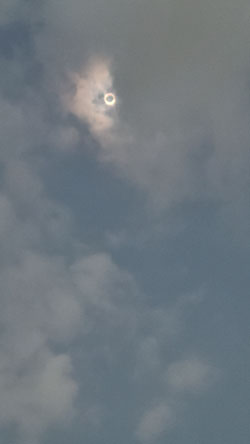
Once totality was reached, we both took pictures, hoping to get that iconic shot. But with our phones, even the brightness of the corona tended to overwhelm the phone camera's sensor, and what you end up with looks like the sun but with a black dot in the center. In actuality, all we actually saw was a dark disk with a bright halo around it:
|
|
|
|
Right at totality, I made a movie to show how dark it had gotten, and I also got my own best shot of the sun totally obscured (save for the brightness of the corona) by the moon.
|
|
|
Totality lasted about four minutes at our location, and when the moon finally revealed the first sliver of the sun, it was pretty amazing how fast everything lightened up.
|
|
|
On the way home, we encountered another aspect of the total eclipse- one we also saw in Missouri in 2017. Typically, shadows cast by the sun show a clear, two-dimensional reflection of whatever blocks the sun’s light. A tree full of leaves casts a shadow full of little holes, places where sunlight passes through, sometimes making rays as reflective material passes through. During the eclipse, these pinholes of light change, becoming crescent waves dancing across the ground as the tree sways.
The refracted eclipse light is called the pinhole effect. It just lets a little bit of natural light through and acts kind of like a lens, and then you're able to see the shape of the actual light source. When the moon is blocking 90% of it, you end up with that crescent shape. It’s a neat way to see the eclipse without having glasses.
Here are two pictures I took of this phenomenon on the way home:
|
|
You can use the links below to continue to another photo album page.
|
April 13-16, 2024: The Fauvism Exhibit at the MFA in Houston |
|
March 13 - April 3, 2024: Our Spring Trip to Florida |
|
Return to the Index for 2024 |