|
August 16-20, 2021: A Trip to Santa Fe |
|
July 10, 2021: An Evening at the Theatre |
|
Return to the Index for 2021 |
Meeting the Girls in Fort Worth
This Thursday and Friday, Prudence and Nancy have come up to Fort Worth for a meeting, and, as they so graciously often do, they asked us to join them on Thursday evening for dinner and Friday afternoon and evening for a visit to the Rockefeller Asia Collection exhibit at the Kimbell Museum and then some supper. We are always happy to see them whenever we can, so we first joined them at the Kimpton-Harper Hotel in downtown Fort Worth for some wine and supper.
|
Add that to the fact that the restaurants she favors are all close by (the Capital Grille is right across 7th Street from the Hotel, and the Cheesecake Factor and Ruth's Chris are just blocks away) and the hotel is a good choice for her and Nancy.
The hotel front desk and bar are on the 24th floor of the old building, so that's where we usually meet them. Being high up, there are usually good photographs to be had.
|
|
We had a nice dinner with the girls at the Capital Grille, and we returned to Fort Worth again the next day so we could meet up with them after their meetings to head over to the Kimbell Museum for the exhibit.
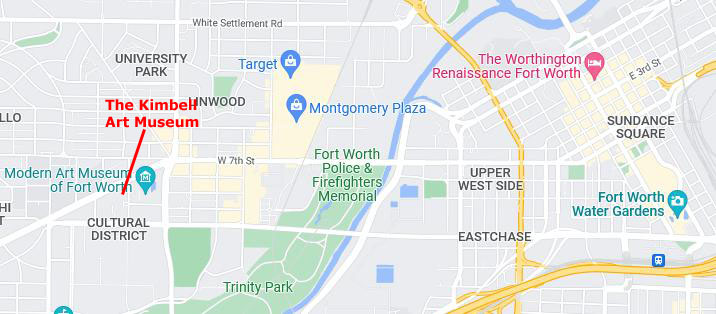
The Kimbell Art Museum
We have been to the Kimbell so many times that I am sure you have seen at least one page devoted to a visit we made there- most of them to special exhibits such as the one today.
|
The original building was designed by architect Louis I. Kahn and is widely recognized as one of the most significant works of architecture of recent times. It is especially noted for the wash of silvery natural light across its vaulted gallery ceilings.
The Kimbell is one of four museums and other attractions in Fort Worth's "cultural district". Nearby are the Fort Worth Museum of Modern Art, the Amon Carter Museum of American Art, and the Fort Worth Science Museum.
Kay Kimbell was a wealthy Fort Worth businessman who built an empire of over 70 companies in a variety of industries. He married Velma Fuller, who kindled his interest in art collecting by taking him to an art show in Fort Worth in 1931, where he bought a British painting. They set up the Kimbell Art Foundation in 1935 to establish an art institute, and by the time of his death in 1964, the couple had amassed what was considered to be the best selection of old masters in the Southwest. Kay left much of his estate to the Kimbell Art Foundation, and Velma bequeathed her share of the estate to the foundation as well, with the key directive to "build a museum of the first class."
|
On Brown's death in 1979, Edmund Pillsbury continued the disciplined expansion of the Kimbell collection, and a decade later it became obvious that more space would be needed. Pillsbury originally thought to expand the existing building, but there was strong opposition to any major alteration of the original Louis Kahn structure. In 2007, the Kimbell solved that problem by announcing plans to construct an additional, separate building on the lawn west of the original building. Designed by Renzo Piano, the new structure opened to the public in November 2013.
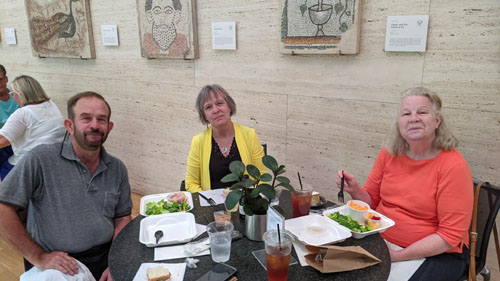
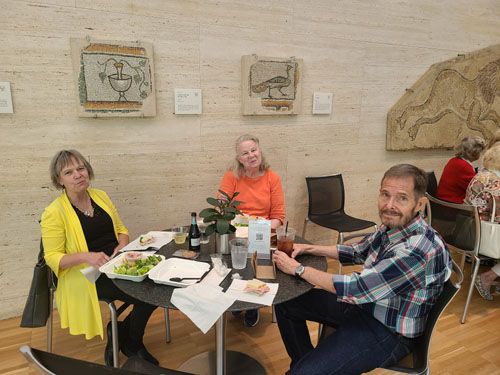
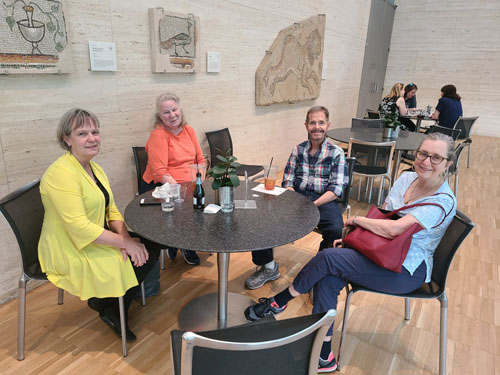
Here are two more pictures we took while we were having lunch in the Kimbell's little restaurant:
 |
 |
On other pages, I have talked a bit about the Kimbell's permanent collection. Founding Director Brown set the tone for the collection by including this directive in his Policy Statement: "The goal shall be definitive excellence, not size of collection." Accordingly, the museum's collection today consists of only about 350 works of art, but they are of notably high quality. The museum owns only a few pieces created after the mid-20th century (believing that era to be the province of its neighbor, the Modern Art Museum of Fort Worth) and no American art (believing that to be the province of its other neighbor, the Amon Carter Museum).
|
(Mouseover Image if Video Controls Not Visible) |
I made a movie as we were walking across from the Khan Building, and you can use the movie player at left to watch.
Beginning in 2006, expansion was again being discussed, but this time Director Timothy Potts and other officials of the Foundation were assuming a new building would be the best option, an idea exactly in line with Louis Kahn's own thoughts for expansion. At that time, the new structure was to be sited on land to the back of the Kahn building. In April 2007, the museum announced that Kahn associate Renzo Piano (The Art Institute of Chicago, the Nasher Sculpture Center in Dallas, the Pompidou Centre in Paris) was chosen to design the new building.
The 85,000 square foot structure would complement the original building but not mimic it. Unlike the original, its lines would be rectilinear, not curvilinear. Like the original, however, it would have three bays with the middle bay stepped back from the other two. The new Renzo Piano Pavilion was officially inaugurated to the public on November 27, 2013.
|
|
(Mouseover Image if Video Controls Not Visible) |
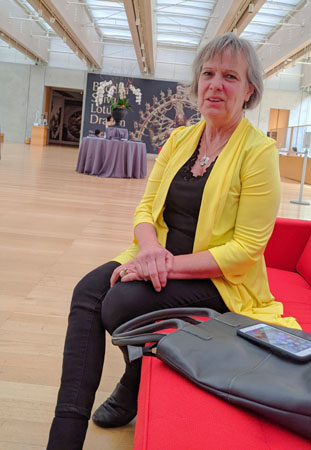
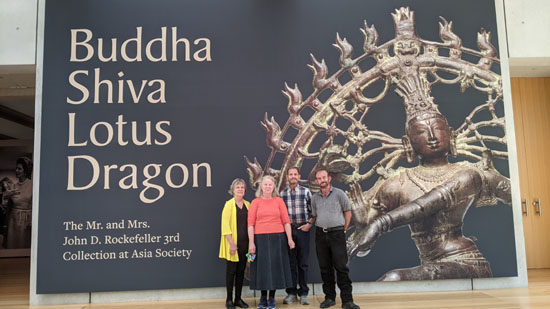
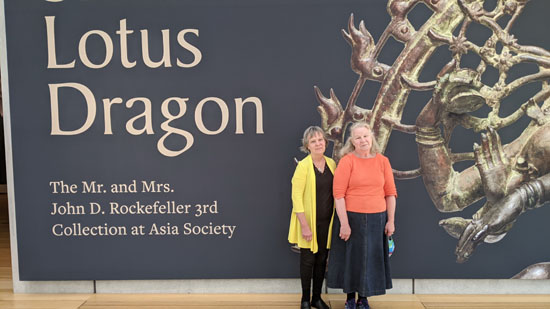
Prudence still has a membership to the Kimbell, so that took care of our admission to the exhibit, but Fred and I got audioguides for everyone; we have found these to be a good investment over the years. Then we had an obliging docent take a couple of pictures of us outside the exhibit:
 |
 |
A Walk Through "Buddha Shiva Lotus Dragon"
Now for the main reason for this album page- a walk through the exhibit of John D. Rockefeller's collection of Asian art from the Asia Society Museum. I photographed my way through the exhibit, listening to the audio guide, admiring each piece, and then photographing it and its explanatory plaque. The exhibit was divided into some loose groups of items, and by and large the audio tour took me though one group at a time. There was not an audio entry for each item, but more than half of them.
So how best to take you through the exhibit? I think the best way is to simply show you a picture of each piece, let you read it accompanying plaque, and, if there was an audio entry for it, let you listen to that entry.
 |
We will travel through the exhibit seriatim, from the opening description of the collection through the various groupings of the items in it.

History of the Collection/Background of the Exhibit
|
|
John D. Rockefeller 3rd, Sherman E. Lee, and the Building of a Collection
|
|
|
|
|
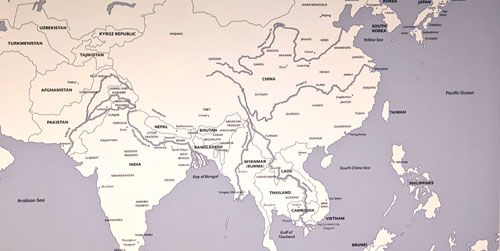
Below is a map of the areas through which the Rockefellers traveled in the acquisition of most of the items in the collection.
|
With those introductions made, we can begin to work our way through the exhibit. As I said earlier, I'll be showing you each of the pieces in the collection, in the order they appeared. Be sure to listen to the Audioguide entries when they appear, as they provide an in-depth explanation of what you might be seeing at the moment.
The Buddha
|
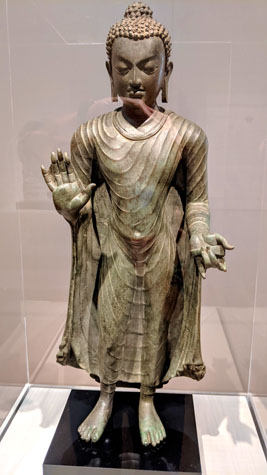
The iconic style of the Gupta period is present in the sensuous full lips, heavy lidded eyes, and oval face of this Buddha. The body, hands, and feet are modeled with a pleasing fullness, and the clinging robe emphasizes the perfection of the Buddha's physical form. These sculptural conventions originated in Sarnath, where the historical Buddha gave his first sermon, and became the prototype for the Gupta style, which influenced regional sculpture in South Asia beyond the sixth century and had an impact on art as it spread throughout Buddhist Asia.
The Buddha raises his right hand in the gesture of reassurance (abhayanudra). His webbed fingers, snail-shell curls, and the bump on top of his head are among the thirty-two lakshanas (auspicious marks) described in Buddhist literature that signify the Buddha’s advanced spiritual enlightenment.
|
|
In the centuries after the Buddha’s death at about the age of eighty, his teachings, or dharma, spread throughout Asia. As the faith encountered new cultures, it evolved into different practice traditions and expanded to include celestial buddhas, savior bodhisattvas, and a wide array of teachers and protectors. Despite these differences, all shared the same goal— to overcome suffering and to end the cycle of rebirth. By the seventh century, Buddhism was a major religious force across South, East, and Southeast Asia. Ongoing interaction among these regions impacted Buddhist practice and artistic production. The works presented here give an indication of the varied artistry, spiritual qualities, cross-cultural connections, and complexity that characterize Asia's Buddhist art.
|
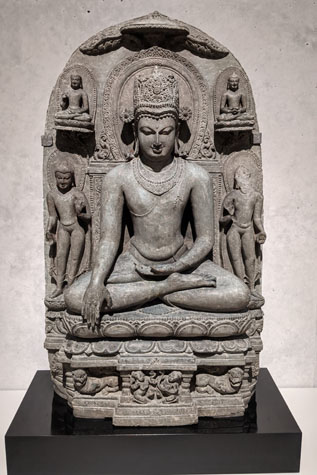
Avalokiteshvara, the bodhisattva of compassion, takes on a wide variety of forms in order to assist the faithful and spread compassion in the world. One of the most important is the esoteric form Khasarpana ('"Sky-Gliding"') Lokeshvara, a bejeweled, youthful deity with the high, matted hair of an ascetic and an image of the Amitabha Buddha on his headdress.
Two standing figures flank the bodhisattva- Tara, a popular female Vajrayana Buddhist deity venerated as an active form of compassion, and Bhirkuti, another manifestation of compassion, with four arms and a stupa in her headdress. The five directional buddhas appear above the bodhisattva's head, four seated on lotus pedestals and one represented by a flaming jewel. Below Lokeshvara's lotus throne are, from left to right: Sudhana, the young pilgrim in search of enlightenment who sought out Avalokiteshvara as a teacher; Suchimukha, a hungry ghost whom the bodhisateva nourishes with nectar that drips from his finger; two donors who supported the production of the sculpture; and Hayagriva, a protective deity who signifies the terrifying but benign power of the buddhas. The elegant proportions, attenuated waistline, and richly carved surface decoration are hallmarks of the Pala style.
|
|
|
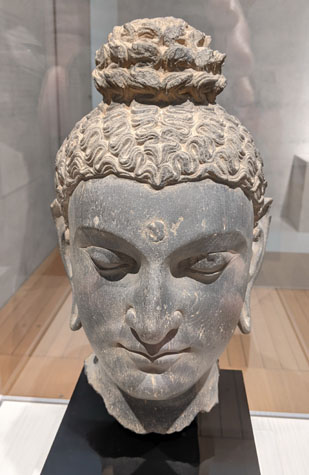
This head of the Buddha Shakyamuni exhibits a number of characteristics that commonly indicate his perfected nature: the ushnisha, che bump atop the head, represents his cosmic openness as an enlightened being, and the uma, the small circle on his forehead, symbolizes spiritual truth. The Buddha's elongated earlobes refer to his early life as a prince. The holes left by the heavy earrings that he removed when he left his father's palace and renounced material possessions remind the faithful that they, too, should reject worldly pleasures.
Located along the ancient Silk Route, Gandhara (present-day Pakistan) was a geographical crossroads where early influences of the western classical world met with Indian imagery and local practices. In this head, the Hellenistic influence is visible in the finely modeled features and facial structure.
|
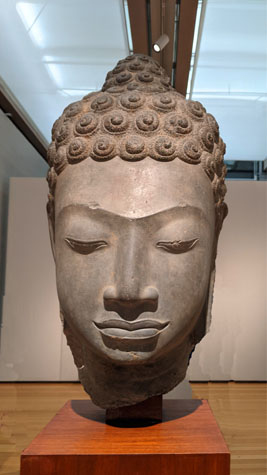
With its high cheekbones, full, wide lips, and broad nose with flared nostrils, this head of the Buddha reflects the influence of the Mon (Dvaravati) people who lived in central Thailand from roughly the sixth to the eleventh century. It also retains much of the iconography for depicting the Buddha developed in India, such as the bump atop the head signifying expanded wisdom (ushnisha) and right-turning, snail-shell curls, which miraculously appeared when Prince Siddhartha Gautama cut off his long hair.
Buddhas and Bodhisativas
By the seventh century, Buddhism was a major religious force across South, East, and Southeast Asia.
|
A second form of Buddhist doctrine, called Mahayana, allowed everyone, monks and laymen alike, to reach enlightenment by performing good deeds and maintaining sincere faith. In Mahayana, the Buddha Shakyamuni became an eternal supreme being, who was now part of an expanded pantheon of past and future buddhas as well as numerous attendant bodhisattvas. In time, many of these buddhas and bodhisattvas had their own cult followings, including Avalokiteshvara, the bodhisattva of compassion; Maitreya, the Buddha of the Future who presides as a bodhisattva in the Tushita Pure Land Paradise; and Amitabha, the Buddha of Infinite Light and Life, who presides over the Western Pure Land Paradise. Mahayana spread to East Asia, as well as to both South and Southeast Asia.
A third strand, Vajrayana (Esoteric or Tantric) Buddhism, developed cantras, texts involving ritual and mceditational techniques that were used as a means of attaining union with cosmic aspects of the Buddha and attaining enlightenment and ultimately nirvana—tliberation from the endless cycle of rebirth.
The Buddha and enlightened beings known as bodhisattvas are the primary subjects of the works in this gallery. In the centuries immediately following his death, the Buddha was represented in art only by symbols. By the second and third centuries AD, however, the Buddha Shakyamuni was depicted in human form, and his perfected and supernormal nature was indicated through lakshanas, or auspicious marks, such as the ushnisha (bump atop the head), representing his cosmic openness as an enlightened being, and the uma (a circle in the middle of his forehead), a symbol of spiritual truth. Additionally, his clongated earlobes recalled the heavy jewelry he wore during his princely life, and his simple monk's robe served to remind the faithful that to seek enlightenment they must surrender their attachment to worldly goods and pleasures. These features, as well as particular mudras, or hand gestures, also served to identify specific episodes from his life.
Bodhisattvas, although able to escape the endless cycle of birth, death, and rebirth (samsara), choose to remain active in the world to assist others along the path to enlightenment. Artists frequently depict bodhisattvas sumptuously adorned, wearing crowns, headdresses, armbands, and necklaces—alluding to the Buddha's life as a prince before attaining enlightenment. They often have the tall, matted hairstyle of an ascetic. Specific bodhisattvas can be identified by their attributes, such as the objects they hold, or other markers. Avalokiteshvara, the bodhisattva of compassion, the most popular bodhisattva in the Buddhist pantheon, appears in many forms—however, in most, a small, seated Buddha can be seen in the crown.
|
In the sixth century, many Chinese Buddhists were focused on their desire for rebirth in a Buddhist Pure Land- a paradise where the believer could concentrate on Buddhist practice, making inroads toward their ultimate goal of attaining enlightenment in another earthly lifetime. The two central figures on this carving are each seated with one leg resting on the opposite knee and the forefinger of one hand raised to the face in a pensive gesture. Although their exact identification is uncertain, scholars agree that the stele represents bodhisattvas in a paradise, possibly the Tushita Pure Land of the Bodhisattva Maitreya, awaiting rebirth on earth as the Buddha of the Future.
At the base of the stele, a pair of guardians and lions flank what appears to be a large lotus bud. Bodhisattvas stand on either side of those seated. Just above their halos are small beings emerging from lotus buds that may represent souls that have been reborn in the paradise. A small bodhisattva flanked by two monks tops the archway above the seated pair, and the entire sculpture is crowned by flying apsaras (celestial beings) and dragons holding drapery that falls from a reliquary or small stupa.
|
|
|
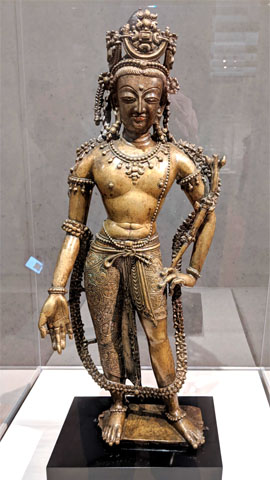
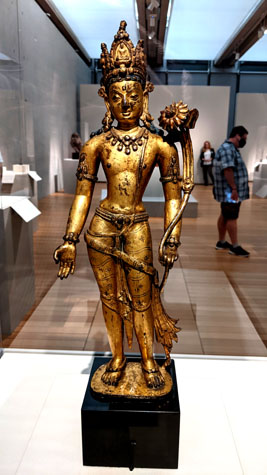
The proximity of Kashmir to northwestern Tibet and the movement of monks and artists between the two led to the transmission of both faith traditions and artistic styles. This bodhisattva’s long, floral-patterned garment, tied at the hips, relates to imagery from India, but his powerful upper torso and exaggerated waistline echo qualities in the Kashmiri tradition, as do the figure’s broad cyes, arched eyebrows, and trapezoidal facial shape. The bodhisattva’s stance, with legs solidly apart, and the long garland of flowers encircling him from shoulder to ankle are often found in images made in parts of western Tibet.
|
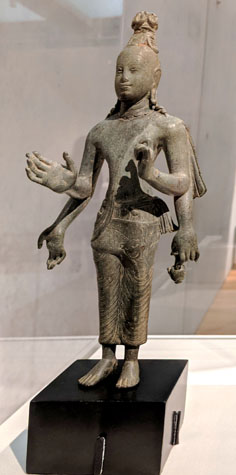
The island of Sri Lanka is strategically placed along the maritime route that has long connected South and Southeast Asia. This sculpture presents a distinctly Sri Lankan version of an ascetic bodhisattva found in art beyond the Indian mainland, reflecting the movement of new expressions of Buddhism that originated in the subcontinent and were transferred via traders and pilgrims along maritime trade routes. The stiff pose, long waist, large hands, short legs, broad oval face, and hair pulled up in a chignon are frequent features of early Sri Lankan sculpture. The figure wears an animal-skin skirt and holds a spouted bottle called a kundika, an attribute of both Avalokiteshvara and Maitreya.
|
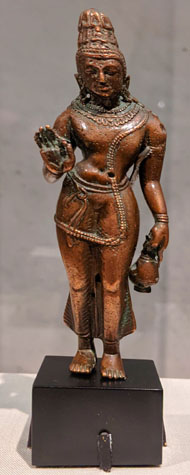
Two attributes, the kundika flask and the image of a seated buddha in the crown, identify this bodhisattva as Avalokiteshvara. The looped cord over the left shoulder and around the right hip and the rosettes on the arm bands are eighth- or ninth-century Sri Lankan sculptural features. Although the hair piled on the head resembles that seen on ascetic bodhisattvas, the presence of jewelry indicates that this Avalokiteshvara is in princely guise. The clinging skirt revealing the sensuous form of the legs is indebted to India's Gupta style.
|
This sculpture is identified as Avalokiteshvara by the Amitabha Buddha in the figure's crown. The bodhisattva of compassion grasps a lotus stem in his left hand and makes the gesture of charity (varadamudra) with his right hand. His pointed crown and jewelry are elaborately modeled. Below his narrow waist, wrapped around his hips, is a garment with a delicate floral pattern that falls below his knees in pointed folds of cloth.
The smooth torso, broad shoulders, and long legs revealed through the clinging cloth reflect the enduring impact of northern India's Gupta style. However, the idealized facia characteristics- the broad face, full cheeks, and elegantly-raised eyebrows above wide-set eyes- identify this sculpture as Nepalese.
|
|
|
Kashmir was an important crossroads between northern India and parts of central Asia, China, and Tibet. The complex and unique Shakyamuni iconography in this work likely reflects these cultural interactions. Seated upon a lotus that rises from a pond inhabited by Kashmir or northern Pakistan (serpent deities), the Buddha holds his hands in the gesture of preaching (dhannachakramudra). Growing from the locus stem are two stupas, each with a staircase on its four sides leading to a small buddha in a niche. An image of a crescent and sun tops each stupa. The Buddha's elaborate costume and crown indicate that the sculpture depicts the consecration of Shakyamuni as King of the Tushita Pure Land, the abode of all buddhas before their final rebirth on earth. The Sanskrit inscription on the base identifies the donors.
|
|
|
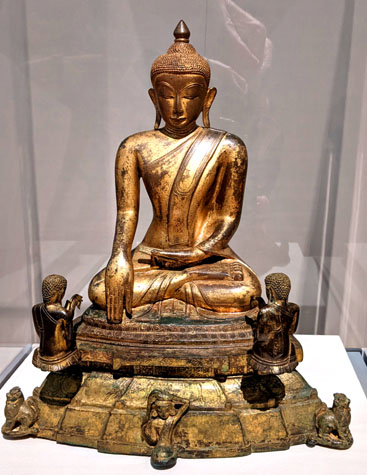
The Buddha Shakyamuni attained enlightenment after a lengthy meditation in which he battled Mara, the god of death and desire. The earth-touching gesture (bhumisparshamudra), seen here, refers to the moment when, challenged by Mara regarding his right to achieve enlightenment, the Buddha reached his right hand down to call the earth to bear witness. In response, the earth, represented here by a female figure on the base, wrung the waters from her hair and swept away Mara and his armies. Two of the Buddha's most important disciples, Mogallana and Shariputra, face the Buddha. Their presence symbolizes the importance of using both skill and knowledge in the search for enlightenment.
|
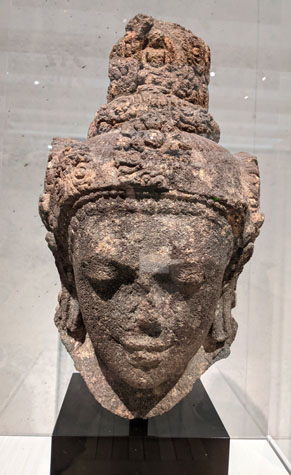
The island of Java is almost entirely of volcanic Head of origin, and the several large Buddhist temple Bodhisattva complexes built in central Java under the Shailendra dynasty (flourished 750-850) were Avalokiteshvara constructed from native volcanic stone. This head likely came from one of these complexes.
The broad face is worn, but the headdress with carved ornaments, including five large decorative plaques on the diadem above the forehead and the figure of a small, seated Buddha at the front center of the tall coiffure, are still discernable. This buddha in the diadem is an attribute of the Bodhisattva Avalokiteshvara.
|
The serpent played a key role in the mythical origin of the Khmer kings, Buddhist rulers who emphasized their identification with the historical Buddha and thus ruled as buddha-kings. The Angkor period saw the emergence of the image of a crowned and adorned Buddha meditating while seated on the coiled body of the serpent king Muchilinda, protected by his cobra's hood.
The seven-headed serpent king Muchilinda is shown here shielding the seated Buddha Shakyamuni from a fierce storm, an incident that took place during the Buddha's sixth week of meditation after his enlightenment. Therefore, this image may have been understood as both an image of the Buddha and a portrait of a Khmer ruler. In this sculpture, the seated Buddha has both hands in his lap in the gesture of meditation (dhyanamudra), the gesture he also made when he meditated under the Bodhi tree and ultimately attained enlightenment. The cobra base and hood are nineteenth-century replacements. The black lacquer and gold-leaf surface are later additions to the original bronze.
|
|
Ceramics and Metalwork
The appreciation of wines, teas, and cuisine has long traditions in Asia, and the associated ceramic and metal vessels are among the most extraordinary exaples of Asian craftsmanship. Artists and artisans developed a myriad of decorative patterns and forms- from elaborate bronze Chinese offering vessels to simple ceramics for Japanese gatherings- to hold or enhance the visual appeal of food and drink. The surface treatments and materials employed to create these objects, many o fwhich originally came from larger sets, often provide clues to their functions and intended uses in domestic, imperial, and ritual settings.
Archaic Chinese bronzes and precious metal objects have primarily come from burial contexts. Ceramic vessels have survived- and maintained much of their original beauty- due in large part to the development of strong, high-fired wares with equally tough glazes, many of which originated in China. Much as faith traditions spread from India via land and sea trade routes, technological innovations, refinements, and decorative motifs likewise spread from China to other parts of Asia, where they were adopted and adapted by local artists.
|
Wavelike patterns cover the body, base, and lid of this "gui", a bronze form that first emerged as one of several styles of ritual food vessels during the Shang period (c. 1500-1046 BC). During the following Zhou period, bronzes like this were items of wealth and power. The dramatic crest at the top of the bowl-shaped lid- which, when the lid is removed and set down, becomes a stand- and the regal dragon handles are excellent examples of the sculptural and decorative qualities of many Eastern Zhou-period bronze vessels. During the Shang dynasty, Chinese bronzes began featuring cunning animal motifs that meld and merge. The tiger with curled tails clinging and biting into the curve in the handle are a continuation of this convention.
|
|