|
Return to the Index for 1971 |
On this page I will be putting those pictures that I want to include in the photo album even though they don't have anything to do with a specific trip or event. You may also find pictures from the occasional trip or event where very few pictures were taken. The dates on which these pictures were taken are in some cases estimates.
January 5: A Couple of Portraits
One of the common purchases that servicemen make here in Korea is clothes- as having clothes made to fit here is cheaper than buying them off the rack in the United States. Some guys go hog wild, but I chose just to have a couple of suits and a sportcoat made for me when a bunch of us visited one of the larger tailor shops in Seoul. My parents wanted to see me in one of them, which occasioned today's pictures.
 In My Bespoke Suit |
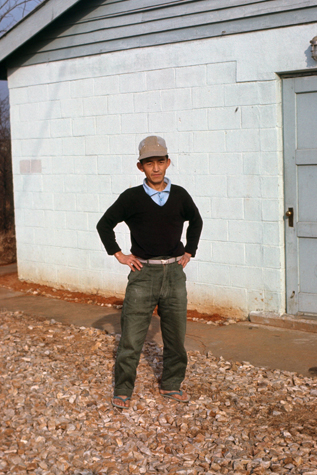
(Picture at left) When the group of us went into Seoul a few weeks ago, we stopped by one of the tailor shops that were generally recommended for US soldiers, and we were indeed treated very well. The prices were excellent, and so I chose a couple of suits- wanting to see how they turned out before getting much else. This afternoon, I've asked our houseboy to take a photo of me outside the BOQ (Bachelor Officer's Quarters) where I live.
(Picture at right)
|
 My Photographer |
January 10: At Yongsan Garrison
On Sunday afternoon, when I left the Kim's house, the easiest way for me to get back to Camp Howze was to walk through Seoul to Yongsan- the headquarters of Eighth Army since the Korean War, and the central garrison for US Forces in Korea. There are relatively few soldiers there; it is more of the administration and control center for the many smaller bases scattered through the northern part of South Korea (most of them north of Seoul, between the city and the DMZ). At Yongsan, I could hop on one of the military buses that travel various routes to the north, stopping at most of the larger installations.
|
But using the Korean bus system to go home is harder, as you have to get to the right station for the right bus line that is going in your direction. And it isn't always easy to find the right bus, or to find one that will take you where you want to go without making a whole bunch of stops on the way.
Yongsan (later usually referred to as Yongsan Garrison) is located in the Yongsan District of central Seoul, about a half mile from the Han River to the south. The name means "dragon hill", which is a nearby high hill in the center of the city which is one of the more popular parks in the city. Yongsan serves as the headquarters for U.S. military forces stationed in South Korea, known as United States Forces Korea (USFK). From 1910 to 1945 it served as headquarters for the Imperial Japanese Army in Korea.
The general area of land on which Yongsan now sits had traditionally been the site of military facilities under former Korean kingdoms. In 1882, Qing troops used it during the Imo Incident. During those times, Korean and Japanese garrisons were on the outskirts of the city in mostly undeveloped land. The Imperial Japanese Army originally created it as a garrison and from 1910 to 1945 it served as its headquarters. After World War II, it became another district in the city of Seoul, the main portion of which was somewhat to the west. At the end of the Korean Conflict, the US Army negotiated with the South Korean government to utilize it as its headquarters, and in the last two decades it has served that purpose. In that time, however, the city of Seoul has spread, and has enveloped Yongsan Garrison. It is now right in the middle of town, and I can only assume that the land has become extremely valuable.
|
If I have not mentioned it already, I am actually the Deputy Finance Officer for the Second Division within the United States Eighth Army. Eighth Army is headquartered in Yongsan, and Second Division is headquartered at Camp Howze. The tensions here in Korea have abated very little since the end of the conflict, and it appears that Eighth Army and Second Division will be here for the long haul. Because of this, one sees a good deal of new construction going on throughout Yongsan, as many of the buildings we currently use are forty and fifty years old.
The facilities here at Yongsan include the largest commissary in the country; it is the headquarters of PAC-EX, the Pacific Exchange System. A post Exchange is like a grocery store, department store, and catalog showroom all rolled into one. Those of us stationed out in the countryside come here for electronics, clothes, and all kinds of other items that are shipped over from stateside. I can buy Korean toothpaste right in Bong-il-chen right next to Camp Howze, but if I want Crest or Colgate, I come here. The exchange doesn't stock everything, of course, so many more items are available in the exchange catalog.
|
NOTE from 2021:
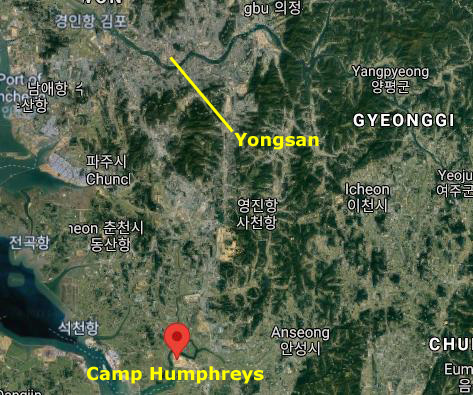
Yongsan continued to serve its function as Eighth Army HQ throughout the rest of the 20th century and into the 21st. But nothing stays the same, and eventually the land became so valuable due to its central location in the megalopolis that Seoul has become that negotiations began for the US and UN commands to relocate out of central Seoul. Agreements were reached, plans were drawn up, and in 2018, the USFK headquarters relocated to the new $11 billion Camp Humphreys in Pyeongtaek some 50 miles south of its old location in Yongsan.
By the end of 2019, more than 20,000 U.S. troops and family members had been relocated to the new site. It is huge, but from the pictures I have seen, it will be many decades before the tree-lined residential streets of the old Yongsan will appear again at Camp Humphreys. While most of the land on which Yongsan stood will be returned to the South Korean government, the U.S. will retain a small portion of land in order to keep open the Dragon Hill Lodge military resort hotel and for a future site to relocate the U.S. Embassy in Seoul.
January 13: All Decked Out
On my last trip into Seoul, I picked up the remaining clothes that I had ordered last month, and I prevailed on one of the other officers to take a couple of pictures of me in them to send back home to Mom and Dad.
 Camel-hair Sport Coat |
(Picture at left) These pictures were taken outside the building at the top of the hill above Camp Howze that serves as the bachelor officer's quarters. It is right by the camp boundary fence, but it's not like North Korean infiltrators are going to make it this far south, though.
(Picture at right)
|
 A Winter Suit and Vest |
January 14: The Southern Contingent
I suppose that in any group of folks there are going to be at least a few interesting people, and among the officer corps that lives in my "hooch" are Bob Cavendish and Theron Lott, officers that I've come to know fairly well.
Bob Cavendish is on the left, and Theron Lott on the right; both of them from the South (Cavendish from Georgia and Lott from Mississippi). There is quite a Southern contingent here, and I of course emphasize that I was born and raised just down the road from Tara. |
The price of freedom is eternal vigilance. Bob has either a Napoleonic complex or chest pains, I'm not sure which. |
January 14: Sunset at Camp Howze
|
Korea can seem much like any other rural area, but at certain times of the year, when the rice is coming up and the paddies are all green, it is quite pretty. In the winter, of course, it is another story entirely.
But there are also times of the day when Korea is really pretty. If you haven't seen some of my photos taken in the morning when there is fog over the rice paddies, then you may see some later on. Here, at the end of the day, is the sunset as seen from our BOQ at the top of the hill.
February (exact day unknown): Bukhansan Mountain
One common sight from the BOQ atop one of the low hills that surround Camp Howze was a mountain we used to call "Crown Mountain" because from a distance it resembled a crown. I don't know that we actually used its real name at any time; that name is Bukhansan Mountain.
Here is an aerial view of the actual mountain and part of the National Park that surrounds it (of course this aerial view was obtained in 2021, but in 1971 the mountain was far from any development and in a wild, almost inacessible area):
|
On the aerial view, I've shown that Camp Howze is to the northwest of the mountain (about 10-15 miles), and Seoul is to the South. In 1971, the mountain was about five miles north of the outskirts of Seoul, but by 2021, when the aerial view was taken, development had come right to the boundaries of the National Park (which, in 1971, had not yet been established).
|
Bukhansan is the highest mountain within Seoul city boundaries. Apart from Bukhansan, there are seven other mountains including Dobongsan and Suraksan that are over 1800 feet high within the city. I have heard from some other personnel that they have known soldiers to visit the mountains for climbing practice.
I thought I might add some information about Bukhansan that is, at this moment, in the future. Popular throughout the year, Bukhansan, and Bukhansan National Park, which was formed in 1983, are renowned for birdwatching, hiking and rockclimbing. Bukhansan attracts a large number of hikers; around 5 million per year.
Since 2002 there has been a movement to revert the name of Bukhansan to "Samgaksan". For many years up until now, the three main peaks of the park have collectively been called "Bukhansan"; however, the original collective name of these three peaks was Samgaksan, meaning "three-horned mountain." The head of the Gangbuk-gu District Office in Seoul is leading a petition to have the central government change the name back to the original.
April: Around My BOQ at Camp Howze
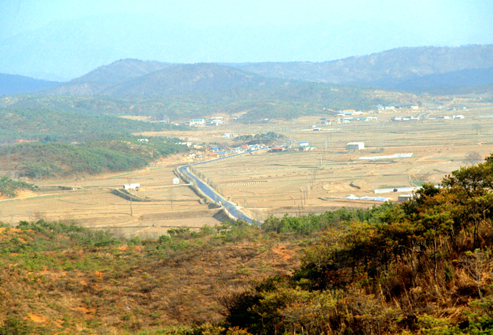
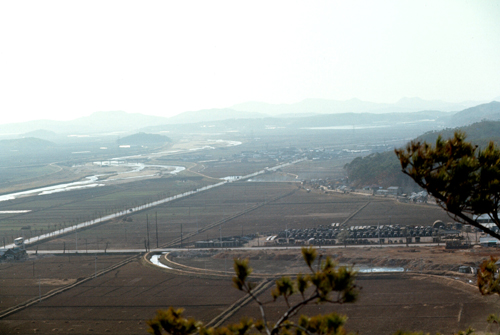
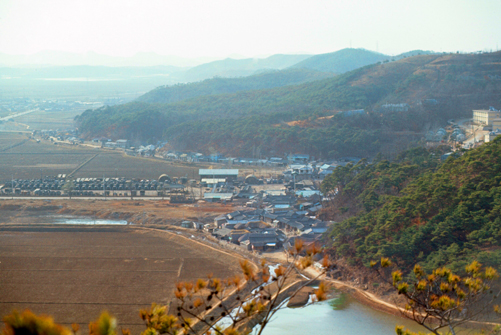
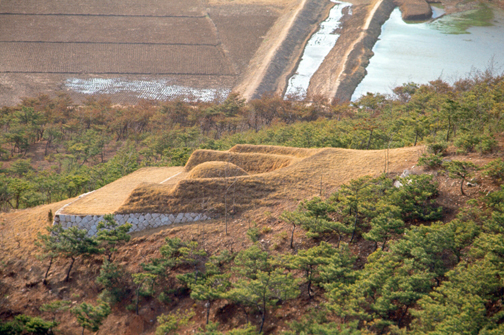
During April, I took a number of pictures from around the BOQ, which, as I have mentioned, is at the top of a hill at the back of Camp Howze, and also a few pictures just outside the gates to the camp. From our BOQ, it is possible to hike a few hundred feet to the south before you come to the boundary fence (and even then, some soldiers have gone beyond that). On one day, I walked five minutes cross-country to another hill crest from which I could see both north and south.
|
|
|
The Third Brigade made quite a few changes around Camp Howze, and as I have said the atmosphere changed as well in the direction of more security-oriented. But the Brigade officers continued to use the BOQ on top of the hill, and I stayed in my old quarters.
This shot was taken from the back of the post, just inside the barbed wire fence.
|
|
|
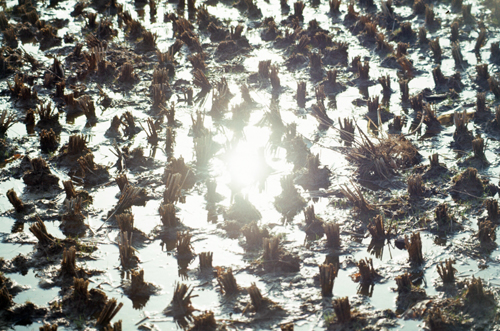
In this picture, a close-up of a rice paddy in Winter, you can see that the ice has melted but the fields have not yet been plowed. This will not occur for another month or so. The fields will dry out a bit, be plowed and planted, and wil then be flooded again for the rice to grow.
This was one of my attempts at art in photography.
November 13: A Motocross Event
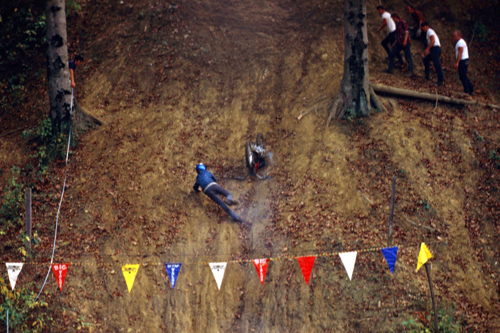
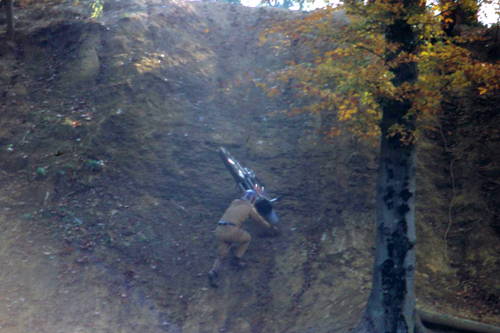
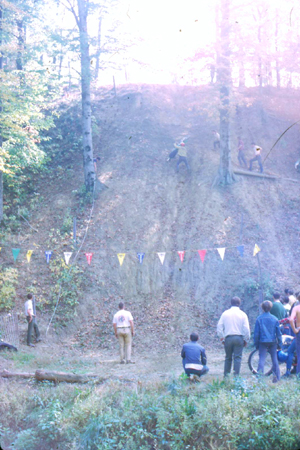
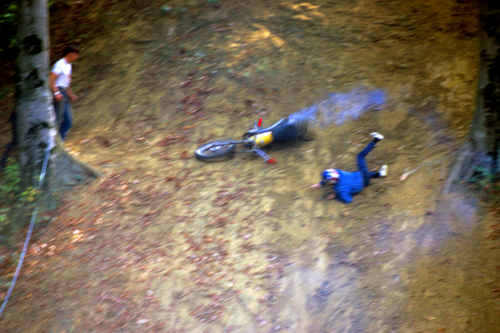
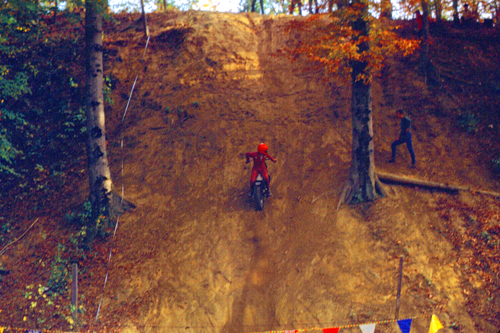
In November, I had an opportunity to attend a motocross event with MAJ Perham, my superior at the Finance Center. I took a few pictures there.
|
|
|
Eventually, I changed positions, becoming a project officer for the JUMPS-Army project, working under General Fazakerley, who commanded the Finance Center. The General had nothing to do with actually conducting the financial affairs of Fort Harrison.
MAJ Perham was a cycle enthusiast; he had a motorcycle that he routinely rode to work, and on some weekends he competed in cycle events around the area. One Saturday, he and some of the other military people and I went to one of these events, and that's where I took these pictures.
Now, I know next to nothing about motorcycle events, and so I probably didn't appreciate the effort that the participants were putting into the races and hill climbs. But it was an interesting afternoon nevertheless.
|
|
You can use the link below to return to the index for 1971.
|
Return to Index for 1971 |