|
August 7, 2025: A Visit to the Dallas Arboretum |
|
March 10 - April 2, 2025: Our Spring Trip to Florida |
|
Return to the Index for 2025 |
As is our pattern now, we are making a Spring trip to Ecuador. But this trip will serve a real purpose. Our Retirement Visas expired in February, and we want to renew them. While we were in Florida, I arranged to have all our documents apostilled, and we will take them with us on this trip. Our lawyers, who are doing the renewal for us, said that the process should take about three or four weeks, and of course we have to remain in Ecuador while the process is taking place.
If you are curious as to why, the reason is that we bring with us clean FBI and Police reports to turn in with our application. If people could just turn in the documents and leave, then Ecuador would not know if the applicant had committed some crime before returning to claim the visa. At least that's the theory (although it seems to me that an applicant could obtain a clean FBI report, say, which is good for 90 days, commit a crime, and then bring the "clean" report to Ecuador). In any event, we booked our return for May 29 to give the Ministry a full four weeks. Little did we know on our arrival that four weeks would not be nearly long enough.
If you are wondering why we haven't just moved to Ecuador and applied for Permanent Residency (which requires an applicant to have remained in the country for 21 months without having left), the answer is that this is a huge step for us to make. With four properties, a couple of houses full of stuff, and certainly friends we would prefer not to leave, we have decided to continue to go to the expense of just renewing the Retirement Visa every two years until such time as we decide what we are going to do. And that decision will depend, in large measure, on what happens in the first two years of Trump II, and especially in the midterms in November 2026. For my part, if things deteriorate as I expect they are going to, I will be beginning the process of moving permanently shortly after the results of those midterms are known.
Getting to the House in Ecuador
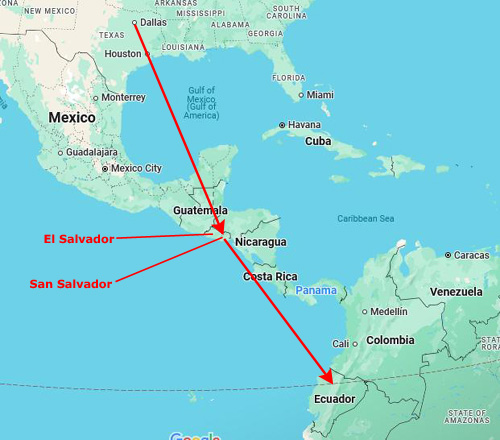
If you've looked at any of our last couple of trips down here, you know the story of how we have come to take Avianca through San Salvador to get down here, rather than American through Miami. If you haven't seen one of those trips, and are curious as to why we fly Avianca, please have a look at our trip from earlier this year or our trip from last October; I won't repeat the entire story here.
|
This time, though, I discovered that on Sundays and Thursdays Avianca has an additional flight that leaves Dallas at about 6PM for San Salvador. This connects to the same onward flight to Quito, but at least the layover in San Salvador is reduced to a little more than an hour, reducing the total travel time to less than 8 hours from the 14 hours we'd gotten used to. The only bad thing about flying Avianca is that the return flight leaves Quito at the ungodly hour of 4AM, getting back to Dallas a little before noon. But that's a minor inconvenience when set against avoiding Miami- and especially Miami customs. (Going through Miami customs takes the better part of an hour; customs in Dallas is, quite literally, a minute or so.
|
|
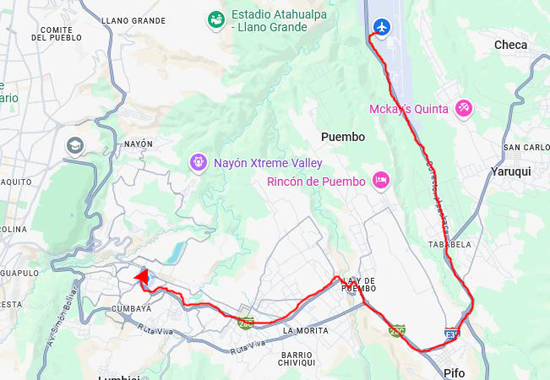
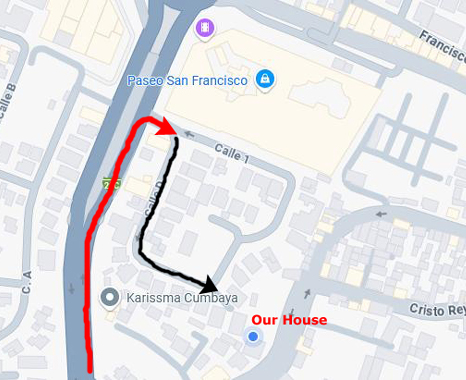
We arrived on time a little after one in the morning. Getting to the house from the airport is routine now, and you'll see the maps above each time we come down here.
Exiting baggage claim, I just pause to locate an Uber, and one usually picks us up outside within a few minutes. The route into Cumbaya is about twenty miles and usually takes about thirty minutes- less late at night when we arrive. We used to just have the Uber drop us at Paseo San Francisco, but I've gotten good enough with the directions to get the driver to drop us right at the gate to our community- Santa Lucia Baja.
We got inside, set up the laptops (I brought a new laptop for Fred; the one he used on the last trip had problems connecting to the house WIFI, and we had to use my own laptop as a hotspot), turned on the upstairs water heater, had a snack, and went off to bed.
We didn't plan any side trips this time; we needed to be available if our lawyers needed us during the renewal process. For reasons that I'll explain in a bit, I took a good many more pictures than last time, and I will group the pictures by the activity that caused me to take them, eschewing any kind of day by day account.
Our Art Collection Expands
|
|
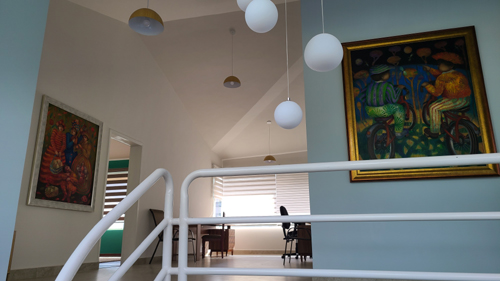
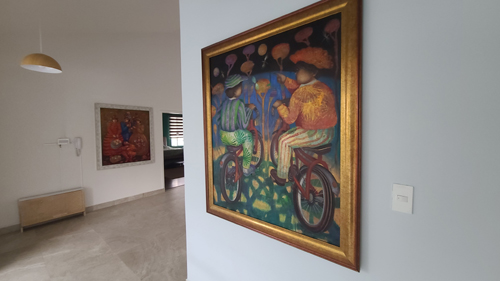
When Paty arrived, we helped get the two paintings upstairs, where we were going hang one of them on the wall between the common area and the bedroom that Greg was to have used. The two pictures above were taken during the process of hanging that picture. The other work was hung on the wall in the common area just to the left of the door to our bedroom. Both are in highly visible places.
|
|
Alfaro is a colorful, visual artist focused on the creation of dreamlike characters. His work explores imaginary worlds, charged with symbolism and emotion, inviting the viewer to immerse themselves in profound and unique visual narratives.
I really couldn't find much online about the artist himself, save for a bit of information on his Facebook page (and I had to set up a dummy account to see even that). The bit of narrative above and the picture at right were taken from that Facebook page.
Here are two more views of the newest of our art acquisitions:
|
|
These two works certainly brighten up our upstairs area.
|
 |
Vintimilla was born in Quito in 1953, and studied architecture at the Central University of Ecuador. His work reflects the influence of his city and his architectural studies. Vintimilla defined himself as an artist "with a distinct technique and style." Jorge Vintimilla's works encompass many hours of work, study and dedication. The detail in his strokes characterize his work; he used various materials and textures to achieve a harmony of form, and this was accentuated by the apparent ease of his brushstrokes. Sadly, Vintimilla died from a brain tumor in late 2018.
Around the House
|
The result has been a kind of ratty looking lawn, particularly anywhere around the tree. A year or so ago, having gotten tired of trying to keep this area looking good, we decided to have artificial turf put down from the front gate all the way to the back wall (leaving the flower beds along the back wall and the wall separating our yard from Mrs. Chiriboga's small house intact). We were very pleased with the result.
Keeping the lawn looking good is now a matter of either picking up individual avocado and lemon tree leaves occasionally or, if there are a lot of them, or we haven't done it in a while, just sweeping them into a pile to be bagged and discarded. The artificial turf is thick enough that it can actually be swept of most detritus, and earlier today we did just that. We also swept the patio itself, and so the yard looks clean and neat, as you can see in the photo taken from the kitchen door that leads down to the patio.
I also took two more pictures of the newly-cleaned yard, and these are below:
|
|
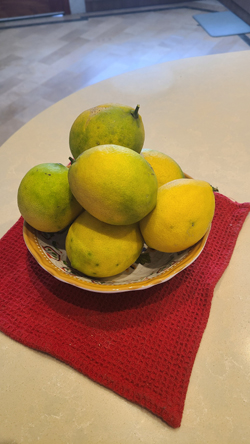
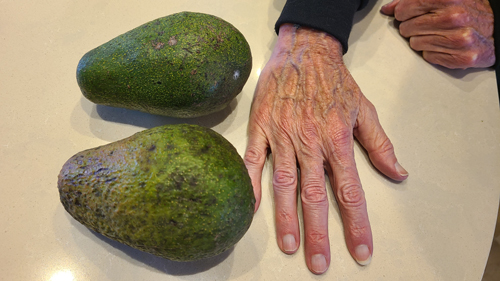
Speaking of the avocado tree, we have been blessed on this trip with "the bounty of the patio".
|
More useful are the avocados, as we have guacamole almost every day. And these aren't small avocados, like the ones you are probably used to. As you can see in the picture below, these fruit are huge:
 |
Santa Lucia Baja
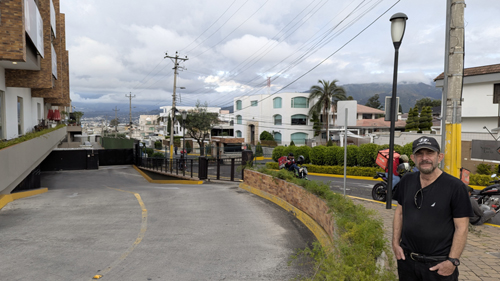
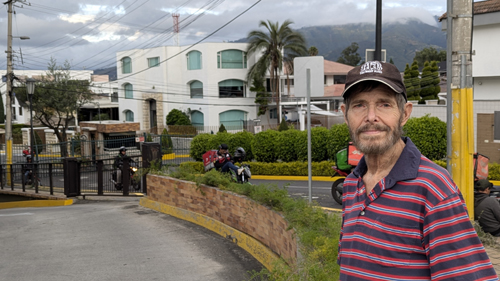
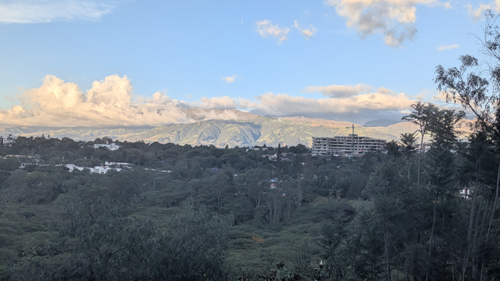
We also happened to take a couple of photos outside our community gate as we were returning from a walk. It was a very cloudy day, with rain showers around, but still the valley is quite scenic:
|
|
Notes on the Visa Renewal Process
We did this because if you change an Avianca itinerary at least two weeks ahead, there are no charges for the change. We continued to do this repeatedly, postponing to June 13th, then to June 2nd and finally to July 1st. Both Fred and I had medical appointments in July- the first of them on the 15th, so if we didn't have our visas by the 13th or so, we might well have to give up and start the whole process again in the fall. We supplied the attorneys with doctor letters detailing the procedures, and they submitted these to the ministry.
On June 25th, we finally heard that our visas were approved- just before I was going to push the return yet again. In those last few days, we were able to obtain our renewed cedulas, and get the printed copies of the visas in hand. We were finally able to return to Dallas on July 1st, with our visas good until June 24th, 2027. Now what we have to do is monitor what happens in the US through the midterms and then, if our decision is to leave, we have seven months or so to accomplish the move to Ecuador, and then begin the 21-month process of obtaining permanent residency.
There Be Bridge Here!
|
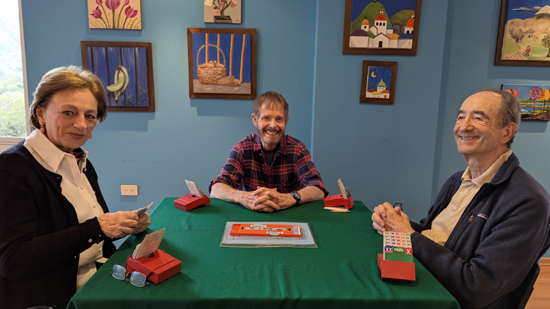
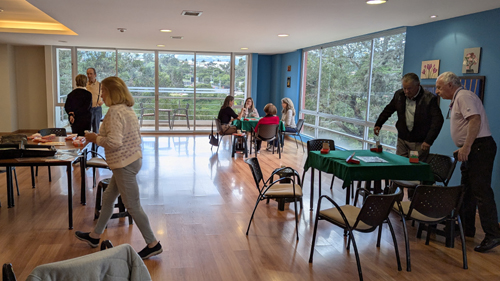
We corresponded via WhatsApp, and I got a lot of good information from Ruben. And he was nice enough to offer to take me to the Wednesday afternoon game here in Cumbaya, introduce me to the playing group, and even be my partner for the duplicate game on May 21st. He picked me up at our community gate and drove me to the Rivera del Rio, a retirement home where the Cumbaya club used the recreation room for their Wednesday afternoon games. We played and actually came in first of the nine teams that played that afternoon!
I met a lot of very nice people, many of whom spoke a good deal of English (and one or two who were expats from the US and of course spoke quite well). I joined the group chat on WhatsApp, which is how people find partners for the games (although a good many partnerships are of long standing). Perhaps because Ruben and I did so well, two people who didn't have established partnerships for this Wednesday game asked if I might want to play with them. Of course I was happy to, and for the next four weeks I had a standing date for the Wednesday game.
|
Professional players are a part of the bridge milieu. I am sure you have heard of such things before; in golf and other sports there are "Pro-Am" tournaments where a professional and an amateur are paired for a charity event or some such. In bridge, this has been taken a step further. To attain the rank of "Life Master" in the American Contract Bridge League (ACBL) these days, a player needs to accumulate 500 masterpoints, with specific requirements for different color categories of points- many of which have to be earned by winning or placing in large tournaments. A similar system is used in the WBF (the World Bridge Federation). Players who are good, but perhaps not good enough, to attain Life Master on their own, still want the title. So, to get it, they will try to pair themselves with really good players at these tournaments. Naturally, those really good players are in demand, and so they charge for their "services." Ruben does this- a least part time.
I don't know what is "fee" might have been to be my partner in these local games, but as I wasn't after a particular title, I didn't even care to find out. And fortunately, I had other people who wanted to play with me. So I will just say that within a week or two, I had standing partnerships for not only this Wednesday afternoon game in Cumbaya, but also for a Monday afternoon game in Quito and a Tuesday afternoon game, also in Quito.
The reason I mention all of this here in my photo album, is that I have taken pictures at these various games, and those pictures will be in this section.
The Wednesday Game in Cumbaya
Let's begin with showing you where, in relation to Casa dos Amigos (our house) the Wednesday game is located.
|
Scala Mall, down the hill about a mile or so from the house is a more traditional mall, with all the stores you might be familiar with as well as South American chains. In Scala, you can find everything under the sun, and for upscale shoppers it is almost a destination- perhaps the Tumbaco Valley's answer to the Mall of America. It comes complete with a huge central space where various programs are put on. With a huge, multi-level parking garage underneath, it is a very, very busy place. So we have often walked down the hill to either shop there, eat at the food court (which actually has quite a good number of quite good eating places), visit our architect (whose office is half a block away), or just get out for a walk.
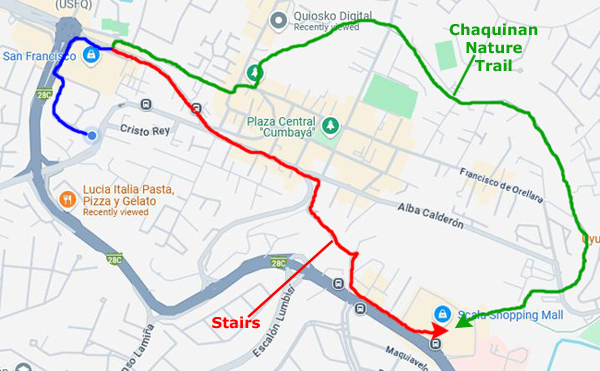
On the aerial view at left, you can see the route we usually follow to get there, circling around Paseo San Francisco, heading down Maria Idrova, and then heading south on the private street that ends in the walkway/stairs down the hillside, past the public swimming pool, and then up to Oswaldo Guayasamin, the main street that runs by Scala Mall.
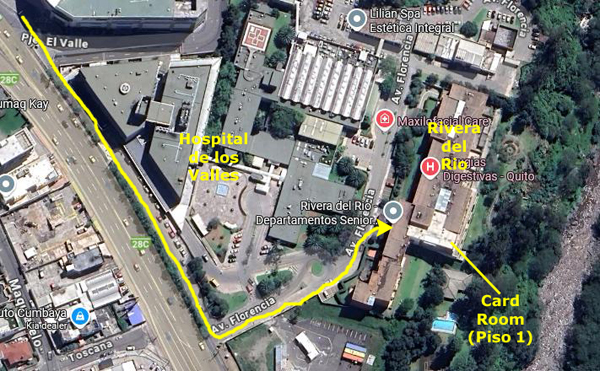
To get to the Wednesday game, I just have to go a bit further, and you can see where I have to go on the aerial view above.
Just southeast of the mall is the Hospital de los Valles (Valley Hospital). (As you know, Ecuador has free public healthcare but, like many countries that do, it also has a private system, available for anyone who chooses to pay out-of-pocket or who have a private insurance plan like we do. The private system offers shorter wait times for elective surgeries, nicer facilities, and, to be honest, more cutting-edge treatments. Most people do absolutely fine in the public system, but those with unusual conditions often opt for the private system. Most expats, like us, pay for insurance, which costs much less than in the United States, to get access to a system more like what they are used to- particularly if they have some health condition that requires a very high level of sophistication.)
|
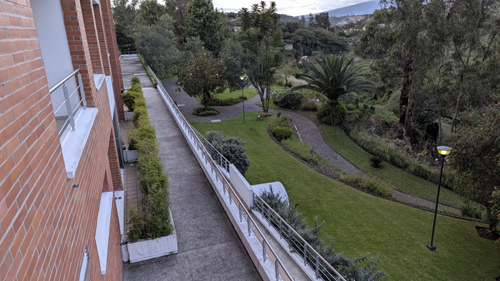
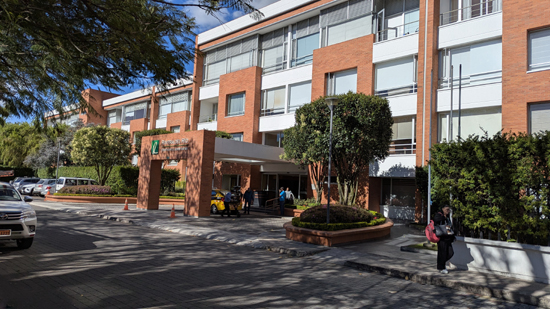
Rivera del Rio is situated on a plot of land that backs up to one of the many streams that run through the Tumbaco valley, and so at least on one side of the building the views are out across a green, undeveloped area. This side of the building is beautifully landscaped, with walkways and short trails, a tennis court, a swimming pool, picnic areas, and other facilities that residents can take advantage of. The card room is located on the second floor (keep in mind that what we would call the second floor is Piso 1; our first floor is called "PB" or "Planta Baja" in Spanish-speaking countries), at the back side of the building. I have marked it on the view at right.
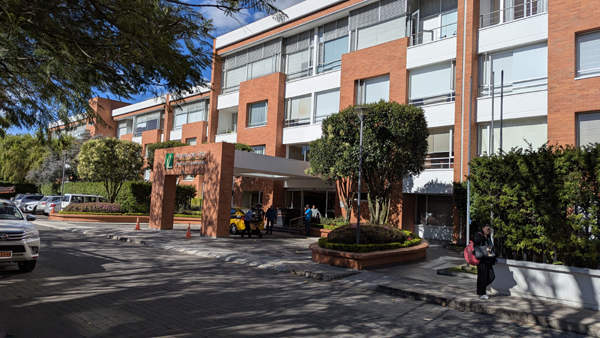
Anyway, when I turn into the driveway to Rivera del Rio, I come up to the main entrance of the building.
|
The Tumbaco Valley Bridge Club has arranged to have its games in what appears to be a kind of recreation space on the second floor, just up one flight of stairs.
This recreation room is located in the southeast corner of the main building. It has a big open space where the card tables are set up, a kitchen and storage area, and even a balcony at the far side of the room. There are lots of windows, and it is an ideal space to have an afternoon of bridge.
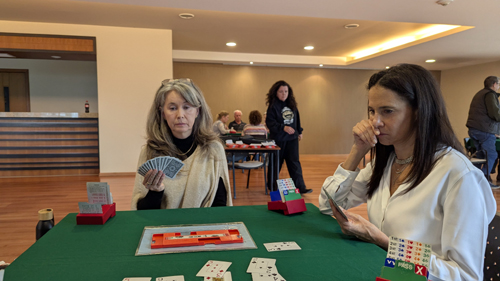
The Club stores all its equipment in that kitchen area, and the first people to show up can help with moving the card tables around, putting green tablecloths on them, getting out the plastic "boards" that contain the four hands of cards, opening up the bidding boxes that are used in lieu of verbal bidding, and shuffling the cards to create new hands from the last time the boards were used. I learned that someone also usually brings something like cookies or some sort of light snack, and these are set out on the counter between the kitchen area and the open space. People often stop at the snack bar of the hospital (which is just across the driveway from the main entrance to Rivera del Rio) to get drinks if they want them.
|
|
Most of the people who play have constant partners for one or another of the games. As a new guy, I didn't have such a partner. Ruben was my first Wednesday partner, and Gustavo was my second. In that second game with Gustavo, I was playing the system he uses (called "2-over-1" and popularized by Audrey Grant, the famous bridge author and teacher) and we happened to get two hands that fit together very well. After following his system to get to game, I thought that we should get further, and so took control of the auction, which eventually ended up with me putting him in a contract of 7 Notrump- the maximum bid in bridge. When I put my hand down for Gustavo to play, he saw why I had gone beyond game. Making the contract depended on either a decent split in one suit or a successful finesse in another, certainly very good odds. As it turned out, Gustavo got both the split and the finesse and so made the contract handily. He was quite pleased; apparently no one has bid and made 7 Notrump in quite some time.
|
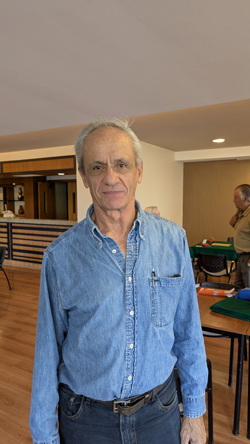
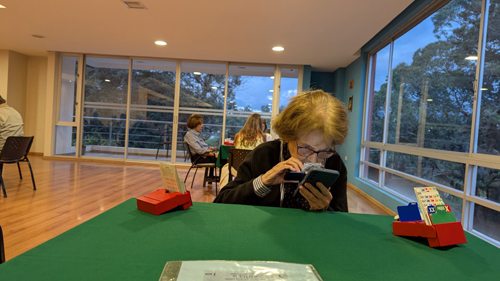
Below is another picture taken at Rivera del Rio; I played with this very nice lady, Elina, one Wednesday when her regular partner was absent. She could neither see nor hear extremely well, but despite all that was a quite good player.
 |
To finish with the pictures I took at the various Wednesday games, here are a few more- all taken at the very first Wednesday game that I played in with Ruben. These were all taken from the balcony at the back of the recreation room:
|
|
Finally, here is a picture of my partner Ruben and Maria Tereza, another good player on Wednesdays and some Mondays as well. Lest you think that I am just making up names, you should be aware that "Maria" is by far the most common female first name around here. In fact, on this Wednesday, there were eight women playing, and six of them had the same first name. This is why I usually refer to the women with two names; you need to add the middle name in order to tell them apart.
On one afternoon, I took advantage of having a "bye" (a round in which my partnership did not play) to walk around the Rivera del Rio complex and see what it was like. I will include those pictures in a separate section devoted to Rivera del Rio itself that can be found later on this page in the section entitled "Rivera del Rio".
The Monday Game in Quito
|
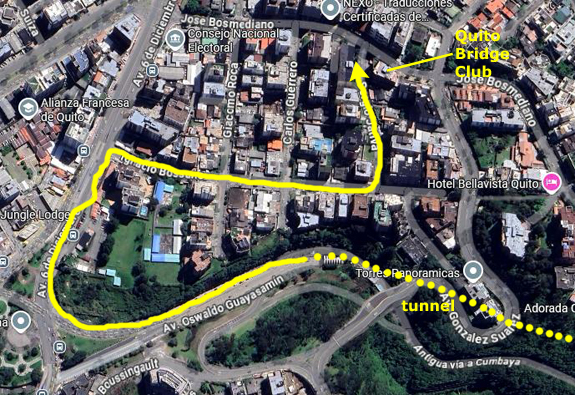
About halfway up, we cross over one of the few actual expressways in the area- Avenue Simon Bolivar- which connects the north end of Quito with its southern part. (The city of Quito is long and thin, completely filling the long narrow valley between two lines of mountains.) The expressway could not be built right through the city; there was simply no room for it. So it was built on the east side of the mountain range that forms the city's eastern border. The road continues climbing to the west until it reaches the mile-long Tunel Guayasamin- Ecuador's longest vehicular tunnel.
|
Three blocks up the steep hill we turn to the left and then look for a parking space, because the actual bridge club is on the ground floor of a residential highrise at the next corner. Usually, we find a space quite close.
|
In an unusual move, the Quito Bridge Club actually bought the ground floor space so they could remodel it to better suit its function as a card room. From wherever we park on the side street, we just walk ahead to the corner, hang a right, walk a few feet and find ourselves at the entrance to the bridge club.
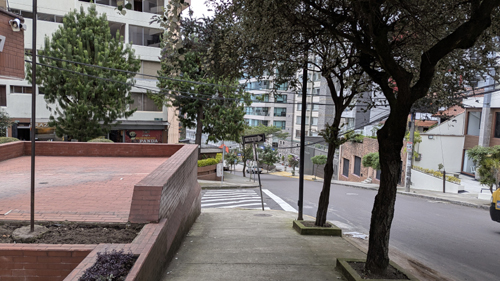
Here are a couple of pictures that I took outside the club on our first trip here:
|
|
The game here in Quito begins at about 3PM, while the Cumbaya game starts at about 4. Counting travel time, I get home a bit earlier from this game, usually about 7-7:30PM. It is odd that games start late; when I played in Charlotte, the afternoon game would start about one and conclude before 5. I suppose that either lunch is the big meal here (as it seems to be in most places) or that people eat dinner fairly late (which also seems to be the case, as we found out in Spain years ago).
Here are a couple of movies I made on my first trip up here with Gustavo. The first was taken shortly after we arrived for my first Monday game with Gustavo, and the second was taken halfway through that first session when everyone takes a break for refreshments.
|
My first movie looks around the bridge club room. |
During the break, I walked around to take a closer look at the space. |
In both those movies, you will see a standing folded screen in front of the entrance. I was never quite sure of the screen's purpose. At first I thought it was for privacy or security, but this seems like a very nice area. The weather is never inclement, but maybe there are times when it is windy, and since the front doors open inward (unusual for a non-residential space), it might be a shield for that eventuality.
|
Below is a view of the club space:
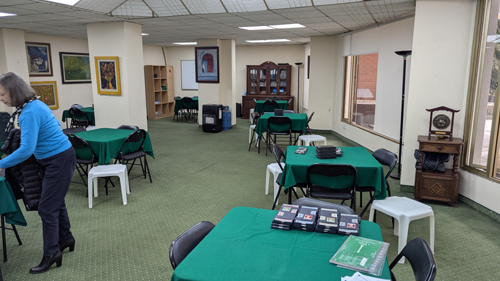 |
Taking a break is not unusual, but here someone actually brings some sort of casserole or sandwiches along with a dessert of some kind, and the break is twenty minutes or so. The club apparently employs a lady who runs the kitchen area; she makes the coffee, sets things out, and cleans up when the session continues. No such person is at the Wednesday game, but then here in Quito the club owns the space they are in.
Also during that break, I went outside to have a look around.
|
Outside, you can see the other spaces on the ground floor of this building (which I think are vacant) and you can also see some of the afternoon traffic. |
|
Gustavo and I played here every Monday but one for the rest of May and June, until we left in July. I really enjoyed meeting all the people at this club; everyone was extremely friendly, and spoke English as much as they could (which wasn't much for some). I could understand a lot of what was being said, until a rapid-fire discussion of a particular hand got going, and then Gustavo had to summarize for me. At one game midway through June, one distinguished lady had a birthday, and of course everyone had to celebrate it. This particular lady uses a wheelchair, and so the director puts her North at table 1, which means that she and her partner stay in the same position at that table throughout the game, while all the other teams rotate around from table to table. Here are a movie and still picture of her birthday celebration during the break:
|
|
|
As it turned out, there were some good picture-taking opportunities on our return trips down to the Tumbaco Valley, and I will include those pictures later on this page in the section entitled "The Road Down from Quito to Cumbaya".
The Tuesday Game in Quito
|
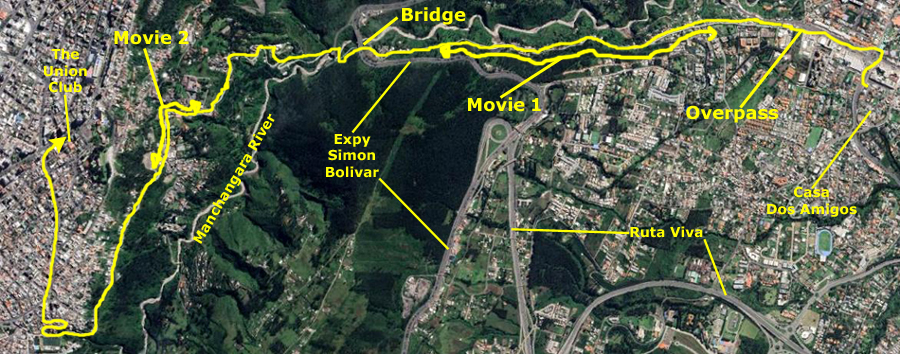
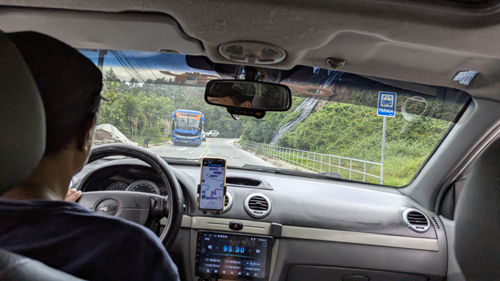
We began by heading up Oswaldo Guayasamin, but at the top of the street where the overpass is, we angled off to the left and followed a smaller road along the edge of the northwest part of Cumbaya heading, it seemed, up into the hills. After about a mile we were basically on what seemed like a country road. This narrow road headed west towards Quito, went under the Simon Bolivar expressway, crossed the Manchangara River and then headed up the winding road the climbs the east side of the mountain range that forms the east boundary of the Guayllabamba River Valley, some two thousand feet higher than the Tumbaco Valley where Cumbaya is located.
|
On another Tuesday, Gustavo gave me a lift to the game, and we followed the same route that the taxi had, and on yet another occasion, when I was playing with Maria Lourdes who became my steady Tuesday partner, Marcelo, who lives near us, gave me a ride, again following the same route. Apparently, although the road is not as good as the one through the tunnel, it is a good deal shorter. And it is very scenic- so much so that I took a number of pictures on the way. These pictures will be a bit out of place here, and so I will put them in a separate section of this page, found below and entitled "The Road Up to the Union Club".
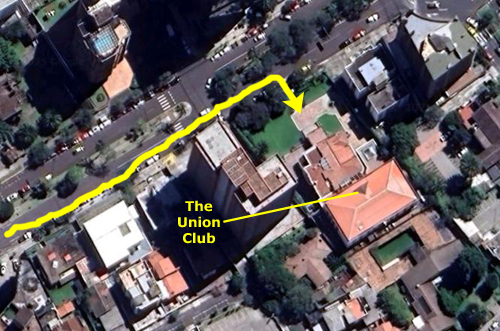
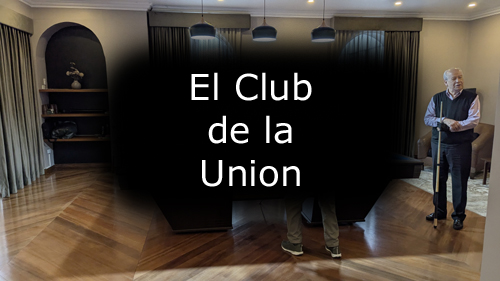
As it turned out, the Union Club was in a beautiful old building on a very nice avenue, and the inside of the building was as interesting as the outside. I took a number of pictures inside the club, and at one of the breaks in the game I wandered around to see what other areas of the building looked like. I am going to put those pictures again in a separate section below entitled "The Club de la Union".
In the actual room we were using, I only took a couple of pictures, with the pictures being on my first visit with Gustavo and my second playing with Maria Lourdes:
|
|
The first time I played with Gustavo, we were second; my first outing with Maria Lourdes had us tied for third, while on the second we were also third, but not in a tie. At my first game with Maria, I had gotten a ride with Marcelo, and since he does the scoring on his laptop, I stayed with him until that was done. Just for my own edification, I took a picture of his computer screen when the scoring was done.
For the games on Monday and Wednesday, the scoring is done by another woman, who uses WhatsApp to share the results later in the evening of the day of each game. There are two WhatsApp groups, one for each club (Quito and Cumbaya), and there are lots of conversations back and forth- particularly on Wednesday mornings when the director asks teams to confirm for that afternoon's game. I happen to be writing this paragraph back in Dallas on a Wednesday morning, and I can tell you that all the usual suspects will be playing today. (I should ask the director to temporarily remove me from the group chats until we return in the Fall, so numerous are the messages. But it is interesting to see how people are doing.)
Walking Down to Scala Mall
We used to walk down to the mall on the trail, but now our practice is to use a walkway and stairs that I scoped out to walk down to the mall and then we return on the trail. In this section I want to put all the pictures that we took over the course of our two-month stay on our walks down to the mall, at the mall itself, and on the trail coming back.
|
|
Maria Idrovo is a typical street for Cumbaya. Once you pass the open area southeast of the mall you are in an area where both sides of the street are rows of little shops- lots of little groceries and restaurants and then a huge variety of specialty shops, drugstores, and many more. I find the street very interesting, and reminiscent of Korea and Japan when I was there.
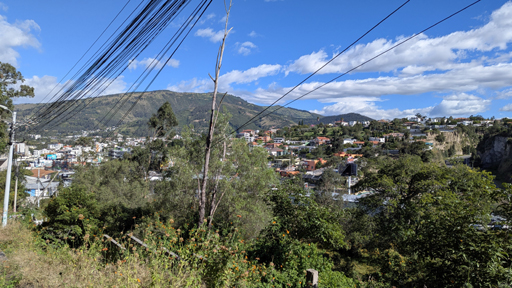
In less that a half-mile, we come to an intersection where the main road curves to the right and heads downhill, and a smaller street continues straight on. We follow that street and after just a block we turn right onto a gated street (gated for cars but open for pedestrians) that also goes downhill to the south and ends at the top of the walkway and stairs. Now, we've taken this route many times, and you may already have seen some pictures from the walkway and stairs. On this trip, in addition to yet another picture of the view from the stairs, I made a movie as I walked down the stairs from top to bottom.
|
This is my movie that begins as we reach the top of the stairs and ends when we get to the bottom. |
|
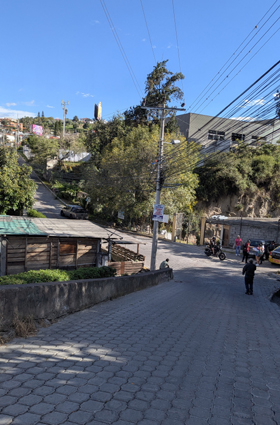
As you saw in the movie, the walkway and stairs end at the top of a street that comes up the hillside from Avenue Oswaldo Guayasamin. There has been some new construction here, and the street where the stairs dump you out is quite new.
|
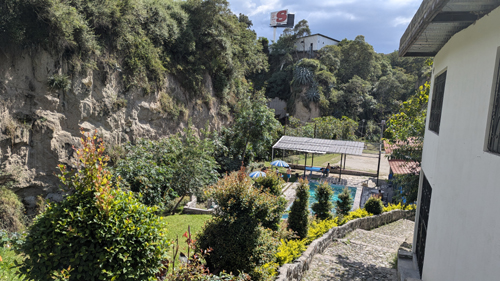
Right at the low point of the street, you pass, on the right, a public swimming pool that is situated much lower than the street, inm something of a canyon on your right. You can see that swimming pool below. This whole area has canyons and ravines like this; a major one parallels the Chaquinan nature trail, and another goes right behind Scala Mall. This seems to be the top of the canyon that runs behind the mall.
 |
Walking up to Avenue Oswaldo Guayasamin and turning left, it is just a few blocks along the street until you can see Scala Mall ahead on the left. As I may have said above, Scala Mall is right beside Hospital de la Valle (Valley Hospital), and just beyond that is the Rivera del Rio, the retirement home where the Wednesday bridge game is held.
|
|
Inside the mall, we will usually be running some errands or stopping in at MegaMaxi for something. And we usually have lunch up in the Food Court. At the top of the escalator that leads up there, there is a bank of windows that look south out across Oswaldo Guayasamin and into the area known as Primavera. On days with sunshine and blue sky, this view is pretty neat:
 |
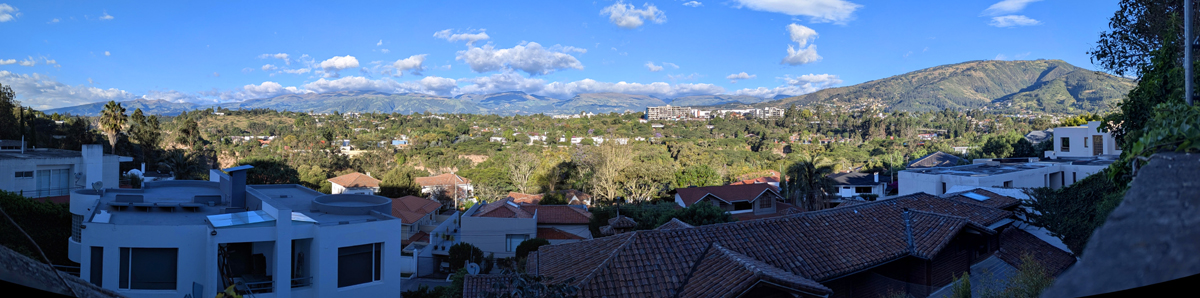
When we are ready to head home, we can leave the mall from the back where there is an access to the Chaquinan nature trail (as you can see on the map at the top of this section. Although returning on the trail is longer, the grade is much less steep than on the stairs, and the views are better. A ways up the trail, there is a spot where the wall that keeps folks from getting down in the canyon that parallels the trail to the north and east gets fairly low, and if you walk over to it there are great views out and across the Tumbaco Valley. Here is a panoramic view of what you can see from here:
|
Continuing up the trail it is another eighth of a mile before views to the northeast open up again, and the wall turns into a fence.
|
|
|
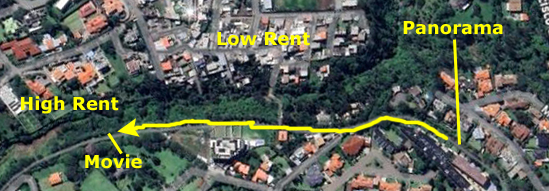
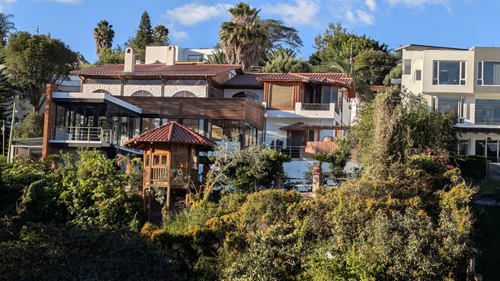
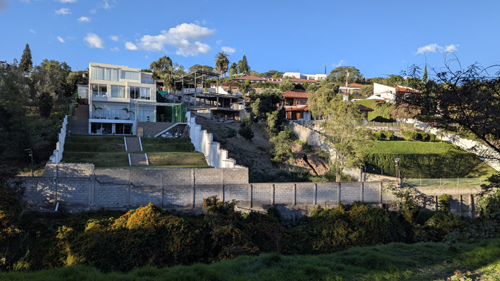
This area is separated from an adjacent urbanizacion (gated community) that would seem to many levels up the income ladder, and it was on the trail across from this area that I made the movie and took the pictures below:
|
|
After passing this "high rent" district, there are no longer houses across the ravine (for whatever reason) until you get closer to the center of Old Cumbaya and eventually the starting point of the trail.
|
|
Here at the official entry, though, there are some benches to sit on as well as a pretty nice mural off to the left of the entry gate. At left and below are some pictures that we took on one of our walks to the top of the trail in which we used this mural as a backdrop.
|
|
So that's a typical walk down to the mall and back. And since I mentioned the retirement home, Rivera del Rio, let's look at it next.
Rivera del Rio
|
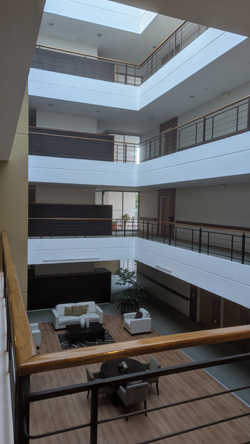
Rivera del Rio is a private housing complex, established under the horizontal property regime, with a unique concept in the country. It is primarily aimed at seniors; however, the regulations allow individuals over 18 years of age. (I discovered later that Jorge, one of the bridge players, had his mom living here before she died. She had been renting one on the second floor.)
Residents enjoy independent living by connecting with a close-knit community, taking advantage of activities and events that foster a pleasant atmosphere. They benefit from condominium-style services, complemented by those of the hotel, healthcare, and entertainment areas.
Its concept is designed for older adults who are able to care for themselves. Those who require permanent, specialized care, attention, or support must supply that support, although they can continue to live here. The staff of Rivera del Rio can, however, provide temporary and emergency assistance.
Suites are on both sides of the long building, so some have street views and some have views of the Tumbaco Valley:
|
|
The Condominium Board actively participates with the Administration to maintain the building in optimal condition and ensure the interests and well-being of residents and co-owners. The building's extensive communal areas includes rooms for workshops, board games, a cinema, and meetings. It also features a library, a prayer room, a cafeteria, a gym, a hair salon, and a spa. Each floor has a lounge with a fireplace and terrace.
|
|
The smoke free, pet free building has 80 suites spread across four floors (the ground floor does not have residences), parking, and storage; the one-bedroom suites are 68 square meters (620 sqft), and the two-bedroom suites are 98 square meters (900 sqft).
|
|
|
Rivera del Rio seems to be a very nice place. Jorge told me that a year ago his Mom was paying something like $1800/month for her two-bedroom apartment.
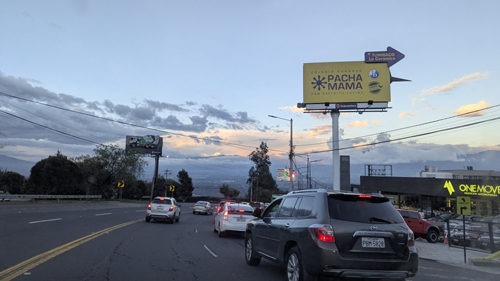
On the Road Up to the Union Club
|
If you are going to the northern part of the city say, at the northern end of Parque Carolina, you can start off on the red route following Oswaldo Guayasamin but then turn north onto the Simon Bolivar Expressway. This road actually continues to the Equator Park and the northern part of Ecuador, but there is a road that branches off to go into the northern part of Quito. We have taken this route to get to the government building that issues cedulas.
To go to the historic old district of Quito, one takes a different route, heading a bit south from our house to pick up Ruta Viva and then follow it around to the south and then eventually into the southern part of Quito. This is the way the taxis and Ubers go when we want to go to the cathedral or the old center square.
But the route to the Union Club takes a different path, shown on the little map in blue. This road angles off from Oswaldo Guayasamin just at the top of our neighborhood section of that street where the pedestrian overpass is.
|
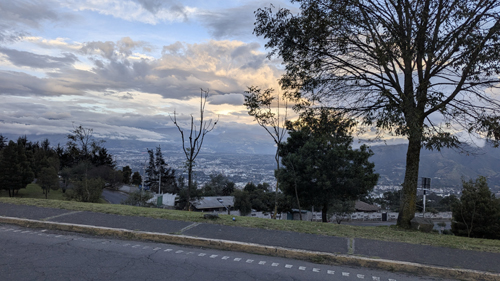
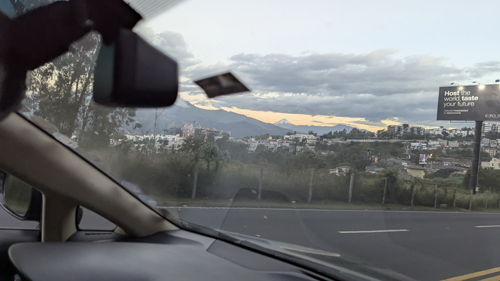
There are many little buildings, homes, and shops along this road, and you also have views to the east across the Manghangara River gorge. Civilization gets thicker and thicker as you climb, and you eventually bear to the right as you cross the top of the ridge, zigzag a bit and then find yourself in the city of Quito proper. Then there is a main road that heads north to bring you to the Union Club. This is the route the taxi took the first time I played at the Union Club, and it was the route that my partners took a couple of other times to get there.
(Oddly, when we returned to the Tumbaco Valley after the game, we did not follow the same route. The reason was, Gustavo told me on one trip, was than when the game is over at 7 or 7:30, there is lots less city traffic and is easier to go north to the tunnel.)
Anyway, on my trips along this route I have taken numerous pictures as well as a couple of movies. For the movies, I have marked on the aerial view above the approximate section of the route covered by each one. I have also marked where the little bridge is as I took a few pictures around there as well.
|
|
If you use the player at left to watch this movie, you will see the typical streetside businesses and house go by, while in the distance, across the river gorge, you will see the mountains that separate Quito from the Tumbaco Valley.
A ways into the movie, the structures thin out, and you can see more of the mountains in the distance. I ended the movie when I saw ahead of us the Simon Bolivar Expressway bridge that carries that highway over the Manchangara River gorge.
I switched quickly from video mode to camera mode, and as we went under this major highway bridge, I was able to get some pictures of it:
|
|
Here are some additional pictures taken here at the river crossing:
|
|
|
|
I've referred numerous times to the Manchangara River, but until we got onto our bridge across the river, I had never actually seen it. But from our bridge crossing I was able to get a really good view of the Manchangara River. While the river looks wild and picturesque, it has long been the center of controversy, as the expansion of the city of Quito has led to significant pollution of the once-wild river. Actually, a court decision last year classified the river as an "entity" under Ecuador's environmental laws. This requires the government of Ecuador and the government of Pichincha state to take care of it and clean it up.
|
|
As we drove, there were interesting views out both sides of the vehicle (taxi in this case) and I was sliding back and forth across the back seat to have a look. To the right, you can see the residential highrises in Quito that have been built right on the crest of the mountain ridge that forms the eastern border of the city. I can only imagine that the views from these residences are spectacular; on this side of the building, there would be wonderful views of the Tumbaco Valley and Cotopaxi volcano, while on the other side there would be tremendous city views, as the land slopes down on the other side of the ridge.
On the right side, there were much fewer houses or other buildings, once we got a bit higher, and so you had views like this of the other side of the gorge cut by the Manchangara River.
Just before we topped the ridge and came down into the city itself, we passed this colorful mural. Now we drove north on city streets until we came to the front of the Union Club. Here are some of the pictures I took along this portion of the route:
|
|
|
|
|
As you can see, coming up to Quito via this route is quite a ride!
El Club de la Union
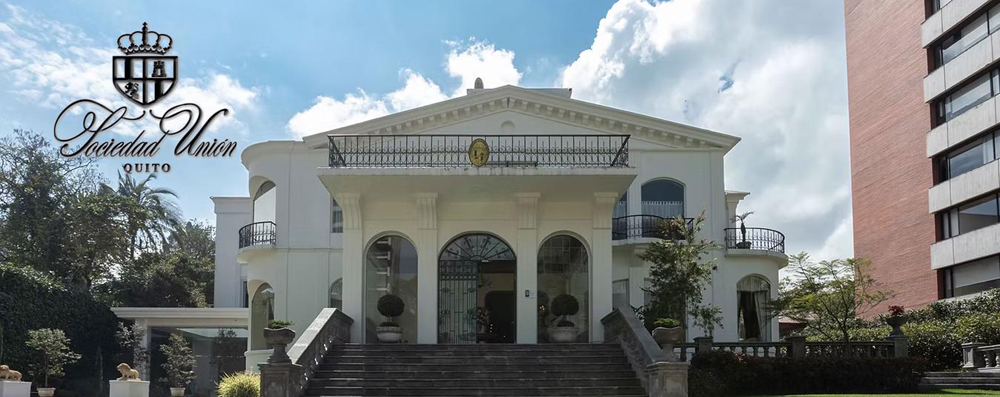 |
In 1993, Mr. Alberto Ferro Torre and Clemente Vallejo Arcos decided to found a social club that responded to a need felt in the capital. Shortly afterwards, Pablo Burbano de Lara Correa, Juan Carlos Correa Mantilla, Christian Degetau and Jaime Aguilera Blanco joined this initiative.
|
During breaks in our bridge sessions, I walked around the second and third floors and took pictures of whatever looked interesting, views outside, and a couple in the basement on our way to the parking garage. The club is very elegant, although I didn't get into many of the private lounge areas and meeting rooms. I have put the pictures I took into a slideshow so you can have a look at them quickly and easily.
To view the slideshow, just click on the image at left and I will open the slideshow in a new window. In the slideshow, you can use the little arrows in the lower corners of each image to move from one to the next, and the index numbers in the upper left of each image will tell you where you are in the series. When you are finished looking at the pictures, just close the popup window.
Returning from Quito
Of course, we can always see the Tumbaco Valley once we get through the tunnel:
|
|
As we came down the side of the mountain, the road turned in various ways, and sometimes the view directly south was quite clear- and directly south of Quito is exactly where the Cotopaxi volcano is. I tried to get the best pictures I could, and here are the two best ones:
|
|
I took one other picture that showed Cotopaxi clearly, but the picture was kind of cluttered- except that Cotopaxi was very clearly visible. So I cropped that picture so you could see the volcano all by itself.
|
At the end of February 2023, the Geophysical Institute of Ecuador reported that Cotopaxi had produced around 8,000 earthquakes since October 21, 2022, amounting to 1,600 events per month. One of those events occurred on our househunting trip down here in early 2023, and it was the quake that I felt when we staying in the Airbnb in La Primavera.
On a clear day, Cotopaxi is clearly visible from Quito. It is part of the chain of volcanoes around the Pacific Plate known as the Pacific Ring of Fire. It has an almost symmetrical cone that rises from a highland plain of about 12,500 feet, with a width at its base of about 14 miles. It has one of the few equatorial glaciers in the world, which starts at the height of 16,400 feet. At its summit, Cotopaxi has a crater that is about a half-mile in diameter and very roughly circular. The crater is over 800 feet deep. The crater consists of two concentric crater rims, the outer one being partly free of snow and irregular in shape. The crater interior is covered with ice cornices and rather flat. The highest point is on the outer rim of the crater on the north side.
Around Our Neighborhood
|
|
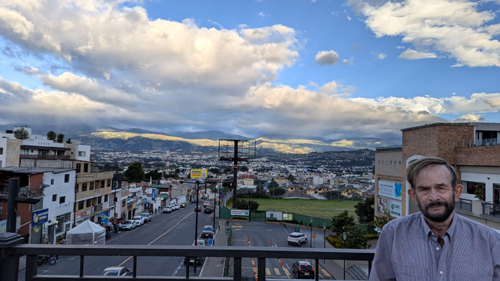
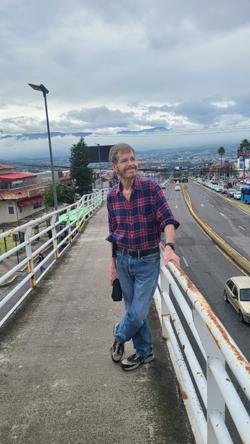
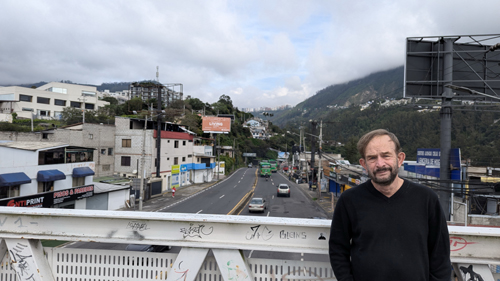
On a different day, Fred and I were standing in front of Paseo San Francisco, and in this picture Fred took you can see the overpass behind me. On a different day, Fred took another good picture looking in the same direction, and you can see the overpass as well as the Tumbaco Valley in the background.
Pictures taken from the overpass are always good, even at night.
|
|
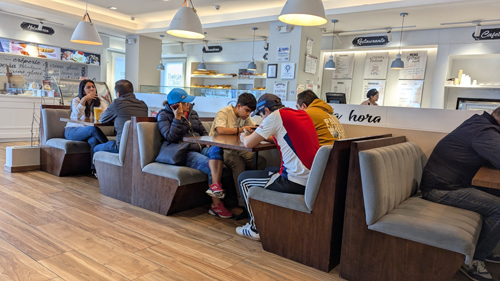
The Paseo San Francisco is pretty central to our activities here. We buy most of our household goods here, we go to the movies here, we do our banking here, and we often eat in the Food Court (which, at lunchtime when the University is in session, is crammed with students). While this Food Court is only half the size of the one at Scala Mall, it has a good variety of semi-fast food (as well as a Baskin-Robbins):
|
|
The east end of the mall houses a number of facilities of the University, including the school clinic, classrooms, and the University Library. On the outside wall of the library there is a huge colorful mural, seemingly in the style of Picasso. You can see what I mean if you look at the mural close up, and you can do so by clicking HERE.
We do a lot of shopping at Villa Cumbaya Mall (a small, one-floor, enclosed mall), and, because the SuperMaxi grocery store is located here, we visit this mall even more often than Paseo San Francisco.
|
|
|
|
At right, Fred is standing at the top of this same ramp, and behind him you can see the road to Quito (one of them, anyway, this being the road that leads up to the tunnel).
One of the reasons we might walk up here is to have a bit of lunch at Baguette, and perhaps pick up something from their bakery. The food is quite good and very reasonable, and we eat here at least once on every trip.
|
|
Plaza Cumbaya also has a number of stores that we visit frequently, including the equivalent of a five and dime, a big hardware store, our main bank, Hornero Restaurant, and an ice cream shop with local flavors. Coming east and going around the corner to the north, are Taconazo (Mexican) and Rusty's Burgers, two other eating places we frequent.
In Central Cumbaya
|
It is a really nice walk- all downhill to get there and some pleasant uphill exercise to return to the house. The walk begins at the house and the short walk to the gate. Then it is around the front of Paseo San Francisco to where we have a choice. What we used to do regularly is to walk down to the overpass that the students use- the one that links the mall to the university. Using this overpass puts us on a side street down the hill to the old town. Problem is, there is not much to see on this route.
The other way is to walk down Maria Idrova- the main street that runs in front of the mall and then down the hill to the old town, and on this route there are lots of little shops and other things to see. There are also more people. So most times we take this route.
|
|
Events occur in this open area fairly frequently. We used to think that they were only once a month, judging from what we could hear from the house, which was some of the music and the occasional announcers. But now we think that events are held just about every weekend. Sometimes they are music-oriented, sometimes they are more like little community fairs. But they are interesting, and sometimes I will just walk over to see what is going on.
As I said, there is a lot to do in this central area of Cumbaya, so let's take a closer look at the area.
|
Many of the pictures were taken at the various new restaurants that we tried, and so I have labelled these restaurants on the map at left, just so you can see about where they were.
Another sizeable group of our pictures and movies were taken in the old square while we were sitting on one of the benches that surround the city fountain (which has not been functioning during this trip), and you can see the square marked on the map.
Finally, we made the occasional movie as we were walking along, and I have labelled the locations where these movies were made.
Anyway, if you want to associate a particular movie or picture with a specific location, use the map at left to do so.
Eating Out
|
|
|
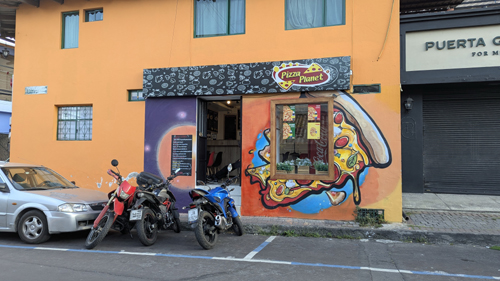
We had seen it numerous times, as it is across from the bakery that Fred favors- the King Bakery (Rey Pan). We had a pizza, which was quite good, although the ingredients and toppings were very Ecuadorian. I took the picture at left, and we had the waiter take the one below.
 |
|
|
|
|
In the Old Square
|
|
|
You can use the movie player below to watch some people using the bubble-making thingy; kids like to chase the bubbles around. I have seen the same guy who has the apparatus here frequently.
|
|
Here are two more movies featuring activities in the square:
|
This movie (Movie A on the map) follows us as we walk towards and then into the square one afternoon on our way to dinner. |
This movie records the square on a pleasant evening near the end of our trip. |
Other Views from Cumbaya
|
On weekends, there is a ride for kids and their parents that winds around the streets near the square. It is pretty cute, and one day I made a movie of it going past./TD> |
Most weekends there is a little market/fair that gets set up on the street next to the church at the east side of the square. Today we bought some honey from one of the vendors. |
The Trip Home
Everything was in order at home, and even the cats seemed to still recognize us.
You can use the links below to continue to another photo album page.
|
August 7, 2025: A Visit to the Dallas Arboretum |
|
March 10 - April 2, 2025: Our Spring Trip to Florida | A
|
Return to the Index for 2025 |